Your Private, Offline AI Assistant.
Take notes and chat with a smart AI agent directly on your Android device. No cloud, completely private, and 100% free.
download
Neural Processing Unit (NPU) Explained: A 2026 Primer
Microsoft's Copilot+ PC certification requires at least 40 TOPS of neural processing power. IDC projects that by 2028, 93% of new PCs will be classified as "AI PCs" with an integrated NPU. The neural processing unit — a chip class that barely existed in consumer devices a decade ago — is on the verge of becoming standard hardware.
Quick Answer: A neural processing unit (NPU) is a specialized microprocessor that accelerates the matrix arithmetic powering AI and machine learning, especially neural network inference. NPUs deliver dramatically more AI performance per watt than CPUs or GPUs — testing shows some NPUs are over 100× more efficient than comparable GPUs at the same power level. They are now standard silicon in flagship smartphones, modern laptops, and an increasing share of vehicles.
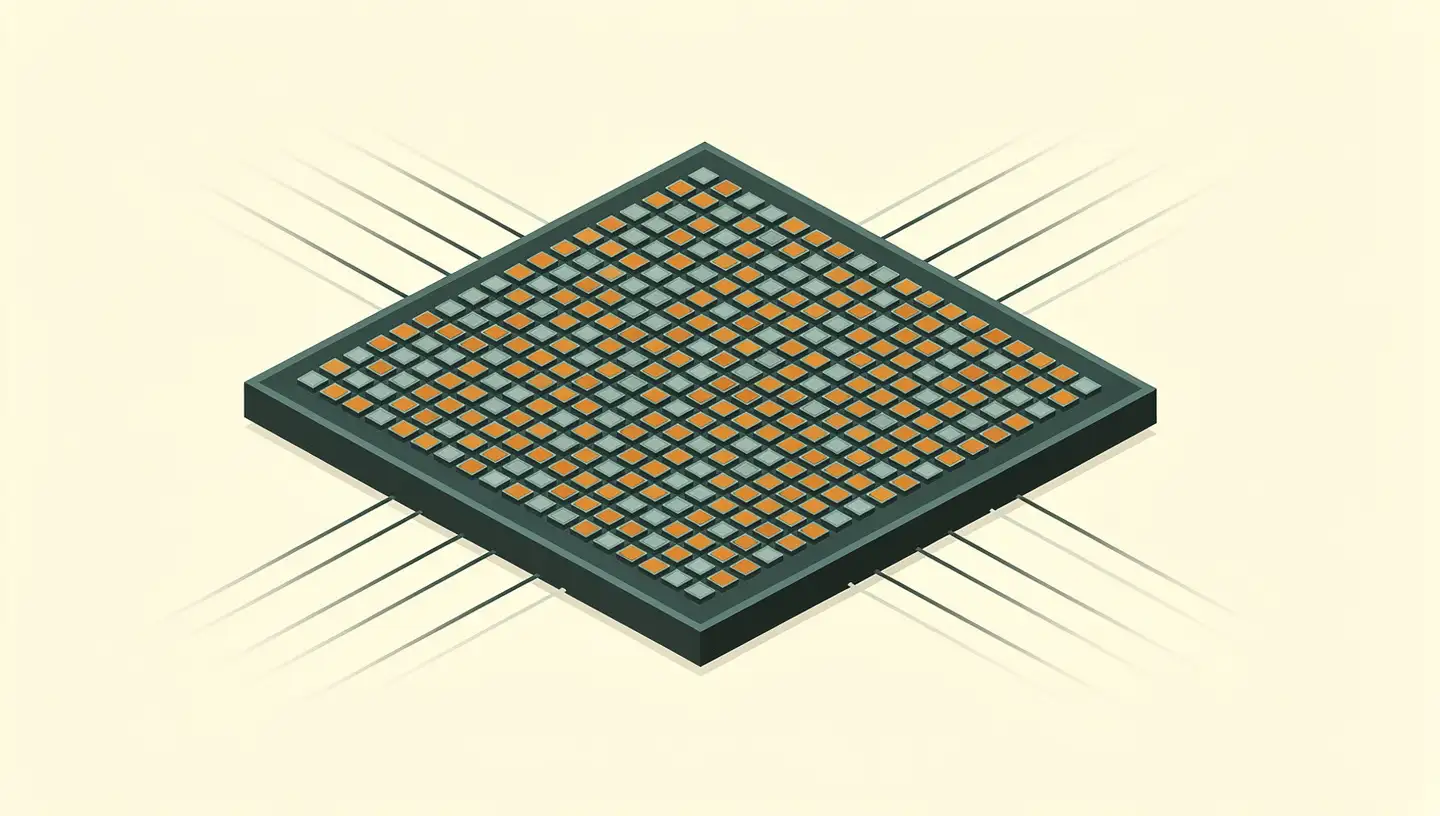
A neural processing unit (NPU), also called an AI accelerator or deep learning processor, is a class of specialized hardware designed to accelerate artificial intelligence and machine learning applications, including neural network inference and computer vision.
AI-generated image
What Is a Neural Processing Unit? The AI-Specific Accelerator
A neural processing unit (NPU) is a piece of hardware customized to perform matrix arithmetic efficiently — the math at the core of AI tasks such as inference. The core idea is specialization: a CPU is a generalist that handles diverse computing tasks; an NPU is a specialist optimized for one category of math.
NPUs are particularly well-suited to low-latency parallel computing tasks: speech recognition, natural language processing, photo and video processing, and object detection. By focusing entirely on these AI-specific operations, NPUs can achieve performance levels that would be impossible for traditional processors — often while consuming far less power.
The result is dramatic efficiency. Testing has shown some NPU performance to be over 100 times better than a comparable GPU at the same power consumption — making NPUs the most energy-efficient way to run AI workloads on battery-powered devices.
How NPUs Work: Architecture for Parallel AI Math
NPUs simulate the behavior of human neurons and synapses at the circuit layer, allowing them to process deep learning instruction sets more efficiently than traditional processors. Where CPUs handle computations on individual scalar values one at a time, NPUs process vectors and matrices of values simultaneously — exactly the operation pattern that neural networks demand.
Three architectural design choices make NPUs particularly efficient:
Single-instruction neuron processing — while traditional processors may require thousands of instructions to complete a neuron processing task, an NPU often completes a similar operation with just one instruction
Low-precision arithmetic support — NPUs support 8-bit and lower precision operations (INT4, INT8, FP8, FP16), reducing computational complexity while maintaining sufficient accuracy for AI inference
High-speed integrated memory — rapid access to model data and weights minimizes bottlenecks during AI processing
NPUs also break larger problems into components for multitasking problem solving, running multiple neural network operations concurrently. The combined effect: deep learning workloads that would saturate a CPU become routine for an NPU operating at a fraction of the power.
NPU vs GPU vs CPU: Why AI Needs Its Own Chip
AI-generated image
If GPUs are already good at parallel math, why design a separate processor for AI?
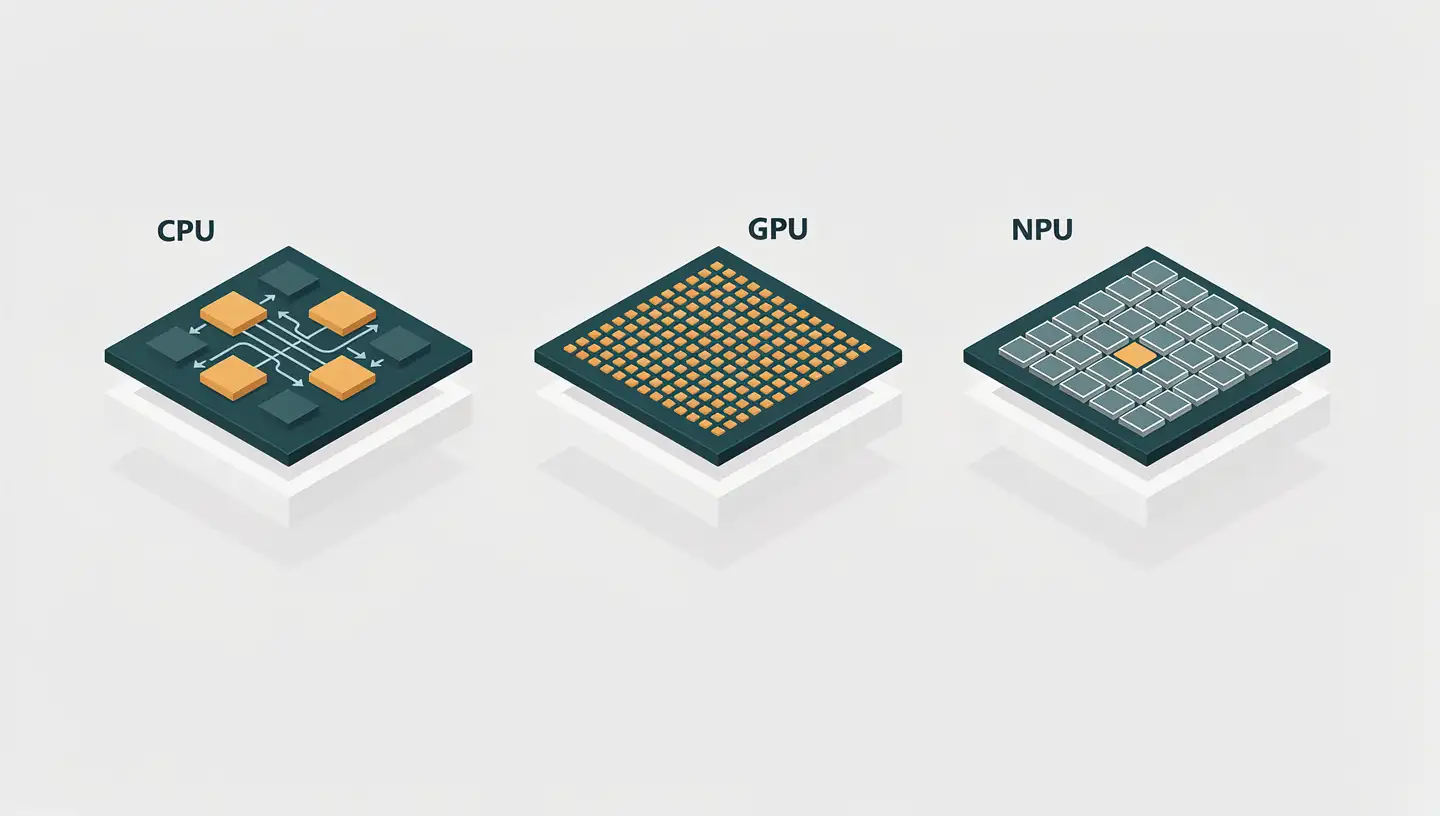
The answer: GPUs are general-purpose parallel processors built for graphics that also happen to be good at AI. NPUs are purpose-built for AI alone — they shed excess features used by GPUs to optimize specifically for energy efficiency in AI and machine learning tasks. NPUs also feature high-speed integrated memory that minimizes bottlenecks related to memory access during AI processing.
Benchmark data shows the practical effect. In academic edge-AI benchmarks:
Matrix-vector multiplication: NPU is 58.6% faster than GPU
LLM inference: NPU outperforms GPU by a factor of 3.2
Sustained throughput across batch sizes: NPU shows consistent performance for tasks like video classification
Power: NPU achieves these results at substantially lower wattage
The implication for device makers: a small NPU integrated into an SoC delivers more AI performance per watt than scaling up the GPU would. That is why every major chipmaker — Apple, Qualcomm, AMD, Intel, Samsung, MediaTek, Google — now ships NPUs in their consumer silicon.
Importantly, NPUs do not replace CPUs or GPUs. They work alongside them, with the operating system or higher-level libraries routing each workload to the most appropriate processor: NPU for AI inference, CPU for general computing, GPU for graphics-intensive work. Standard APIs handle the routing: CoreML on iOS and macOS, DirectML on Windows, and TensorFlow with LiteRT Next on Android.
How Fast Is an NPU? TOPS, Latency, and Benchmark Results
NPU performance is typically measured in TOPS (trillion operations per second). TOPS represents the theoretical peak AI inferencing capability based on the processor's architecture and frequency. Microsoft's Copilot+ PC certification requires NPUs with at least 40 TOPS of performance.
Leading consumer NPUs as of 2026:
Manufacturer | NPU | TOPS |
|---|---|---|
AMD | Ryzen AI 300 | 50 |
Qualcomm | Snapdragon X Elite | 45 |
Apple | A19 Pro Neural Engine | 35 |
Apple | M3 Neural Engine | 18 |
AMD | XDNA in Ryzen 8040 (Hawk Point) | 16 |
Intel | Core Ultra (Meteor Lake) | 11 |
Real-world benchmark performance is now being standardized through MLPerf Client v0.6 — the industry's first standardized evaluation of large language model performance on client NPUs. In that benchmark, Intel's Core Ultra Series 2 processors generated the first word in just 1.09 seconds (fastest NPU time-to-first-token) and achieved the highest NPU throughput at 18.55 tokens per second on the Llama 2 7B model.
Procyon AI Benchmarks now include NPU support across all major Windows vendors as of January 2026. The routing differs by platform:
On Qualcomm devices, the Procyon AI Text Generation Benchmark uses Qualcomm Gen AI Inference Extensions (GENIE) — the first token is processed on the NPU while subsequent inference is handled by the CPU
On Intel devices using OpenVINO, the entire text generation workload runs on the NPU for consistent acceleration
The Procyon AI Image Generation Benchmark has also added AMD XDNA2 NPU support
Who Makes NPUs? Major Manufacturers in 2026
The NPU market is now a competitive landscape across consumer, automotive, and cloud silicon.
Smartphone SoCs
Apple Neural Engine — integrated into A-series and M-series chips across iPhone, iPad, and Mac. The A19 Pro Neural Engine delivers 35 TOPS
Qualcomm Hexagon — powers Snapdragon mobile and Snapdragon X laptop platforms. The Qualcomm AI Engine combines the Hexagon NPU with the Adreno GPU, CPUs, and Sensing Hub to accelerate on-device AI across laptops, smartphones, vehicles, XR, IoT, and robotics. The Snapdragon X2 Elite focuses specifically on generative AI capabilities
Samsung, Huawei, Google Tensor — each ships proprietary NPUs in flagship smartphone SoCs
MediaTek — released the LiteRT NeuroPilot Accelerator in December 2025, a ground-up successor to the TFLite NeuroPilot delegate. It provides a unified API for deploying generative AI to MediaTek NPUs across millions of devices, with a fallback mechanism that routes inference to GPU or CPU when the NPU is unavailable
Laptops and PCs
Intel Core Ultra (Meteor Lake, 2023) — 11 TOPS; later Core Ultra Series 2 pushes performance significantly higher and led MLPerf Client v0.6 benchmarks
AMD Ryzen AI 300 — 50 TOPS based on XDNA architecture, succeeding the 16 TOPS XDNA NPU in the Ryzen 8040 series
Apple M-series — Neural Engine integrated alongside CPU and GPU on every M-series SoC
Cloud and Specialty Processors
Google TPU — Application-Specific Integrated Circuit (ASIC) used in Google Cloud Platform, designed to act as a large-scale neural processing unit for training and inference
Automotive
The automotive NPU market is the fastest-growing segment. It was valued at USD 2.8 billion in 2025 and is projected to reach USD 21.5 billion by 2035 — a 22.4% CAGR. NPUs power real-time perception, decision-making, and predictions across Advanced Driver-Assistance Systems (ADAS), infotainment, and driver monitoring systems. NVIDIA expanded its DRIVE Thor platform in 2024 with high-performance AI computing for autonomous vehicles; NXP Semiconductors enhanced its S32 platform in 2025 with integrated AI acceleration; Qualcomm improved its Snapdragon Digital Chassis in 2025 with AI-enabled cockpit personalization and advanced driver monitoring.
Real-World Applications of NPUs in Your Devices
Smartphones
On smartphones, NPUs enable real-time language translation, computational photography with AI-enhanced image processing, voice assistants that understand context, and facial recognition for security. The crucial property is that processing happens on-device — features work without an internet connection and sensitive data stays on the phone.
On consumer devices, the NPU is designed to be small, power-efficient, and fast enough to run small AI models, supporting low-bitwidth operations such as INT4, INT8, FP8, and FP16, often measured in TOPS.
Laptops and AI PCs
NPUs are powering a new category of "AI PCs" that can run generative AI applications directly on the device — AI-powered photo editing, video generation, document summarization, and code assistance. Intel claims its NPU-equipped processors achieve 1.7 times more generative AI performance compared to previous generation chips without an NPU. Major PC makers, including Dell and HP, now offer AI PCs equipped with NPUs as standard configurations.
Edge Computing and IoT
NPUs enable IoT devices to make immediate decisions without cloud connectivity — critical for safety applications, robotics, and any scenario where latency matters. Qualcomm's AI Engine accelerates on-device machine learning and computer vision in robotics platforms, supporting smart, power-efficient industrial and consumer robots.
Automotive ADAS
Modern vehicles rely on NPUs for real-time perception, lane recognition, and driver monitoring. The escalating demands of autonomous driving have driven NPU performance requirements from tens to hundreds to thousands of tera-operations per second over recent years.
Limitations and Trade-Offs of NPU Architecture
NPUs are powerful, but they come with constraints worth understanding before evaluating them as a silver bullet.
Precision trade-offs. NPUs typically support 8-bit or lower precision operations to reduce computational complexity and increase energy efficiency. This works well for AI inference but is unsuitable for calculations requiring exact mathematical precision — those workloads still belong on the CPU.
Model optimization burden. Unlike GPUs that run neural networks with minimal modification, NPUs require models to be specifically optimized and quantized for NPU execution. Developers convert models to formats compatible with the target NPU using tools like TensorFlow Lite, CoreML, or vendor SDKs — adding a development step that does not exist on general-purpose hardware.
Software ecosystem fragmentation. Each platform has its own API: CoreML for iOS and macOS, DirectML for Windows, TensorFlow with LiteRT Next for Android, plus vendor-specific SDKs from Qualcomm, MediaTek, AMD, and Intel. Applications often need significant rewrites to run optimally across NPU vendors — unlike the more uniform CUDA ecosystem around NVIDIA GPUs.
Capability ceiling for large models. Consumer NPUs are optimized for smaller neural networks. State-of-the-art LLMs with tens or hundreds of billions of parameters still require GPU clusters; on-device NPUs target much smaller models.
Silicon area and cost. Adding NPUs to devices increases manufacturing costs because they often involve fabricating separate chips or adding extra hardware structures. NPUs also occupy only a small fraction of an SoC's die area — physically limiting the complexity of neural networks that can run directly on them.
Heterogeneous computing, not replacement. NPUs do not replace CPUs or GPUs — they complement them. The OS or higher-level library routes the right workload to the right processor: NPU for AI inference, CPU for general computing, GPU for graphics-intensive tasks.
The Future of NPUs and On-Device AI

AI-generated image
The first neural network accelerators appeared in 2014, coinciding with the widespread adoption of the VGG16 architecture for image classification. In the decade since, demand for neural network processing in mobile phones has seen approximately a 30× performance jump, and the underlying architecture has evolved from basic CNN acceleration to supporting Transformers, YOLO v5, and increasingly multimodal generative models.
The trajectory ahead is striking. IDC projects that by 2028, 93% of PCs will be classified as AI PCs with integrated NPUs. The global neural processor market was valued at USD 178.43 million in 2025, with projections of growth to USD 876.13 million by 2034 — a 19.34% CAGR.
For developers and users alike, the practical implication is that on-device AI is becoming the default rather than the cloud fallback. The hardware is here, vendor frameworks are converging on shared standards, and the question is shifting from "can my device run this?" to "which on-device model should I run?"
Frequently Asked Questions
What is a neural processing unit (NPU)?
A neural processing unit (NPU) is a specialized microprocessor designed to accelerate AI and machine learning tasks, particularly the matrix arithmetic that powers neural network inference. NPUs are optimized for low-bitwidth operations (INT4, INT8, FP8, FP16) and deliver significantly higher AI performance per watt than CPUs or GPUs handling the same workload.
What is the difference between an NPU and a GPU?
GPUs are general-purpose parallel processors used for graphics and AI alike. NPUs strip out graphics-specific features to optimize purely for AI energy efficiency. In benchmarks, NPUs achieve 58.6% faster speeds in matrix-vector multiplication and outperform GPUs by 3.2x in LLM inference tasks — at substantially lower power consumption.
What does TOPS mean for an NPU?
TOPS (trillion operations per second) measures an NPU's theoretical peak AI inferencing capability. Microsoft's Copilot+ PC certification requires at least 40 TOPS. Current leading NPUs include AMD Ryzen AI 300 (50 TOPS), Qualcomm Snapdragon X Elite (45 TOPS), and Apple A19 Pro Neural Engine (35 TOPS).
Which devices have NPUs in 2026?
Most flagship smartphones (Apple A-series, Qualcomm Snapdragon, Samsung, Google Tensor, Huawei) and modern laptops (Intel Core Ultra, AMD Ryzen AI, Apple M-series) include NPUs. IDC projects 93% of PCs will be AI PCs with integrated NPUs by 2028. The automotive sector is also rapidly adopting NPUs for ADAS and autonomous driving systems.
Do I need an NPU for on-device AI?
You don't strictly need an NPU — many on-device AI tasks can run on a CPU or GPU — but an NPU runs them faster and with significantly less battery drain. Features like real-time translation, voice recognition, computational photography, and on-device generative AI run dramatically better on hardware with a dedicated NPU.
Conclusion
Neural Processing Units have moved in less than a decade from research silicon to standard components in flagship phones, laptops, and increasingly vehicles. By specializing for the math that powers neural networks — and by accepting precision trade-offs and ecosystem fragmentation in exchange — they deliver dramatically more AI performance per watt than CPUs or GPUs at the same workload.
If you're evaluating a new phone or laptop in 2026, the NPU is no longer a footnote in the spec sheet. It determines which AI features run locally, how fast they respond, and how much battery they consume. Three things to check: published TOPS figures, vendor benchmark scores (MLPerf Client, Procyon), and — for laptops — Microsoft Copilot+ PC certification, which requires the 40 TOPS threshold.