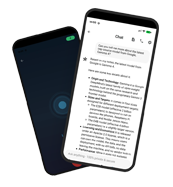
Your Private, Offline AI Assistant.
Take notes and chat with a smart AI agent directly on your Android device. No cloud, completely private, and 100% free.
download
On-Device AI for GDPR Compliance: Data Minimization
GDPR Article 5(1)(c) requires that personal data be adequate, relevant, and limited to what is necessary. On-device AI is one of the few architectures that satisfies this requirement structurally: by processing data on the user's phone or sensor, no personal data is transmitted to a server in the first place — which eliminates the most common compliance failure mode in cloud-based AI deployments.
Quick Answer: On-device AI processes data locally on a user's phone, sensor, or edge device — without transmitting raw personal data to external servers. This directly satisfies the GDPR Article 5(1)(c) data minimization principle and supports the Article 25 "data protection by design and by default" requirement. Apple Intelligence, Google AI Edge, and edge-AI platforms like Luxonis all use on-device processing as their privacy foundation. Where on-device alone is insufficient, federated learning offers a complementary technique that keeps raw data on-device while still enabling collaborative model training.
On-device AI (closely related to edge AI when applied at the network edge) is the deployment of AI models that run inference directly on the user's device — smartphone, sensor, camera, or IoT endpoint — without transmitting raw personal data to cloud servers.

AI-generated image
What Is On-Device AI? Distinguishing It from Edge AI
On-device AI and edge AI are closely related but not interchangeable. On-device AI specifically refers to processing that occurs entirely on the end user's personal device — a smartphone, sensor, or IoT endpoint. Edge AI is a broader category covering any local processing at the network edge, which may include gateways, edge servers, or other infrastructure sitting between endpoints and the cloud.
For GDPR purposes the distinction matters: on-device AI is the most privacy-protective end of the edge spectrum because personal data never leaves the user's device at all. Edge AI in a gateway or local server still keeps data out of the public cloud, but the data has already crossed at least one boundary.
The underlying technology — specialized hardware accelerators and optimized models — applies to both. Edge AI platforms like Luxonis deliver real-time AI processing on-device, enabling applications such as surveillance and robotics to make immediate decisions while keeping data local. The same platforms support offline operation, allowing devices to continue processing personal data without internet connectivity.
GDPR Data Minimization: The Legal Basis
The GDPR's data minimization principle is enshrined in Article 5(1)(c), which requires that personal data be adequate, relevant, and limited to what is necessary in relation to the purposes for which it is processed. The UK Information Commissioner's Office (ICO) emphasises a practical version of the same rule: organisations must collect and hold only the minimum amount of personal data necessary to fulfil their specified purpose, and must periodically review what they hold to delete anything that is no longer relevant.
Article 5(1)(c) does not exist in isolation. Article 25 mandates that data controllers implement technical and organisational measures — such as pseudonymisation — to effectively apply data protection principles like data minimisation. This is the "data protection by design and by default" requirement: organisations must restrict the amount of personal data collected, the extent of its processing, the period of storage, and its accessibility from the start, not as a retrofit.
The UK GDPR's ICO guidance is explicit: data protection by default means limiting your use of personal information to what is necessary to achieve each specific purpose. Applied from the design stage, this approach reduces longer-term costs by preventing the need for future large-scale redesigns and helps build user trust.
These two articles together create a direct mandate for architectures that minimise unnecessary data collection and transmission — and on-device AI is one of the cleanest ways to satisfy that mandate structurally.
How On-Device AI Satisfies the Data Minimization Principle
By processing data directly on the device rather than offloading it to the cloud, on-device AI keeps personal data local and reduces reliance on external servers. When data never leaves the device, the risk of exposure during transmission is eliminated.
Three architectural properties of on-device AI line up directly with the GDPR's requirements:
No transmission of raw personal data — Article 5(1)(c) requires processing only what is necessary; the cleanest way to limit transmission is to not transmit at all
Localised, sovereign processing — data remains within defined geographic or organisational boundaries, helping comply with local data sovereignty rules in addition to GDPR
Offline operation — devices continue processing without internet connectivity, preventing both unnecessary transmission and the dependency risks associated with cloud outages
On-device encryption adds a second layer of protection: any sensitive data processed locally remains encrypted at rest, reducing the risk of exposure even if the device is compromised.
A canonical illustration: a smart security camera using on-device AI can analyse video locally to detect intruders and only send alerts — not full footage — to the cloud. The visual data, which would be high-sensitivity under GDPR, never traverses the network. Only the abstracted output (an alert) does.
This pattern generalises. Anywhere an organisation can replace "send raw data to cloud for analysis" with "analyse locally, send only the result" the data minimization picture improves immediately.
Real-World On-Device AI Implementations
Apple
Apple has long championed on-device processing as the cornerstone for the security and privacy of user data — ensuring that data existing only on user devices is disaggregated and not subject to any centralised point of attack. When on-device computation is possible on iPhone or Mac, users retain control over their devices; researchers can inspect both hardware and software; and runtime transparency is assured through mechanisms like Secure Boot.
For requests that exceed on-device capability, Apple introduced Private Cloud Compute (PCC), designed to extend the high levels of privacy and security of Apple devices into the cloud — processing personal user data without it being accessible to anyone other than the user. PCC enforces stateless computation: data received is used exclusively for the immediate user request and is never available to anyone else, with strong limits on privileged access during operational monitoring and troubleshooting.
Google AI Edge Eloquent processes all machine learning tasks locally on the user's iOS device, ensuring that audio, confidential conversations, and personal data remain secure and do not leave the device. The app provides on-device speech-to-text dictation without requiring a server connection, and uses Google's Gemma technology to intelligently edit spoken input — removing filler words like "ums" and "uhs" while capturing the user's intended meaning. All of this happens locally.
Third-Party On-Device AI
The On-Device AI: TTS, STT & Agent app on iOS allows users to run local AI models — including Llama, Gemma, and Qwen — on Apple devices, ensuring that sensitive conversations, documents, and transcripts remain on the device unless the user explicitly chooses to connect to an online provider. Users can analyse sensitive documents offline and build searchable knowledge libraries entirely locally.
Edge AI in the Enterprise
In healthcare, edge AI devices can monitor patient data in real time and alert medical staff immediately if anomalies are detected — keeping sensitive medical data on local devices while still enabling timely clinical response. The same architecture pattern applies in finance and any sector where privacy is paramount. On-device AI processing inherently helps protect users' privacy in consumer applications and offers similar protection for sensitive applications in medical, enterprise, and government settings.
When On-Device Alone Isn't Enough: Federated Learning
Some use cases legitimately need to learn from data across many devices — improving a recommendation model, a language model, or a medical classifier. Pure on-device processing cannot accomplish this on its own. Federated learning is the standard answer.
Federated learning trains algorithms collaboratively across multiple decentralised devices holding local data samples — without exchanging the raw data. Each device computes local model updates and sends only those updates (not the underlying personal data) to a coordinating server, which aggregates them into an improved global model.
This approach supports GDPR principles in several specific ways:
Personal data does not leave the local device, significantly reducing the risk of data breaches and unauthorised access
The need for explicit consent or other legal bases for data transfers is minimised because the raw data is never transferred
Individuals' rights under GDPR — access, rectification, erasure — are easier to honour because data remains on the user's device
Federated learning can be combined with differential privacy: noise is added to model updates before transmission, making it difficult to infer any individual data point from the aggregated model. The combination gives a defensible answer when a regulator asks how raw personal data is protected during distributed training.
Limitations and Trade-Offs
On-device AI is not a universal solution. Three constraints matter most in practice.
Compute Limits Cap Model Complexity
Advanced edge AI solutions must balance workloads effectively, which can limit the complexity of models that run locally. Flagship smartphones and dedicated edge hardware can run sophisticated models; older devices or low-power IoT sensors may only support simplified versions of the same model, potentially reducing functionality. Some workloads (very large generative models, multi-modal reasoning over long contexts) still legitimately require cloud compute.
Physical Device Compromise
Cloud infrastructure benefits from enterprise-grade physical security. Edge devices typically do not. Physical access — through theft, loss, or tampering — creates an attack surface that simply does not exist with cloud processing. Mitigations include hardware security modules, tamper-resistant storage, on-device encryption, and secure boot, but the responsibility shifts to the device manufacturer and the user.
Audit and Oversight Are Harder
Centralised cloud infrastructure can be continuously monitored and audited. Edge devices distributed across millions of endpoints cannot be inspected the same way. Demonstrating GDPR compliance to data protection authorities therefore requires deliberate engineering: robust local logging that the user can access, clear documentation of what processing happens where, and accessible data processing reports that satisfy accountability requirements under GDPR Article 5(2).
Update Distribution
Local AI can operate offline — but that independence means model updates, including security patches, require a separate distribution mechanism. Organisations need robust update pipelines that themselves do not become a new vector for compromise.
Frequently Asked Questions
What is the GDPR data minimization principle?
The GDPR data minimization principle, set out in Article 5(1)(c), requires that personal data be adequate, relevant, and limited to what is necessary in relation to the purposes for which it is processed. Organisations must collect and hold only the minimum amount of personal data needed to fulfil their specified purpose.
How does on-device AI support GDPR compliance?
On-device AI processes personal data locally on the user's device, eliminating the need to transmit raw data to external servers. This directly supports GDPR's data minimization principle (Article 5) and the data protection by design and by default requirement of Article 25 — both of which require organisations to limit the personal data collected, processed, and stored.
What is the difference between on-device AI and edge AI?
On-device AI specifically refers to processing that happens entirely on the end user's personal device — phone, sensor, or IoT endpoint. Edge AI is a broader term covering any local processing at the network edge, which may include gateway servers or infrastructure between endpoints and the cloud. On-device AI is the most privacy-protective end of the edge AI spectrum.
Is federated learning GDPR compliant?
Federated learning trains models collaboratively across decentralised devices without exchanging raw data, keeping personal data at its source. This decentralised approach minimises transfer requirements and supports GDPR's data minimization principle. Differential privacy can be added — by introducing noise to model updates — to further reduce the risk of inferring individual data points.
What are the limitations of on-device AI for GDPR compliance?
On-device AI faces three main constraints: limited compute on smaller devices restricts model complexity; physical access to the device creates new attack surfaces not present in cloud architectures; and audit oversight is harder when processing is distributed across millions of endpoints, which complicates demonstrating compliance to regulators.
Conclusion
On-device AI is one of the cleanest structural answers to GDPR's data minimization mandate. By processing personal data on the user's device, organisations eliminate the most common compliance failure mode in cloud AI deployments: transmitting more raw data than the stated purpose requires. The architecture maps directly onto Article 5(1)(c) and the Article 25 "data protection by design and by default" obligation, and it has been operationalised at scale by Apple, Google, and a growing ecosystem of edge AI platforms.
The practical playbook for any team handling EU personal data:
Default to local processing wherever feasible — phones, sensors, edge boxes
Reserve cloud processing for the cases where it is genuinely needed — large models, cross-user aggregation, computationally intensive analysis
Use federated learning when collaborative model training is required across user devices, paired with differential privacy on transmitted updates
Engineer for auditability — local logs, accessible processing reports, clear documentation of what happens where
On-device AI does not replace every cloud workload, but it sets a higher floor for what counts as a privacy-respecting AI architecture. As regulatory scrutiny intensifies, that floor is moving up.