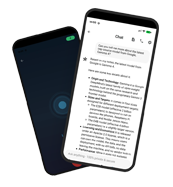
Your Private, Offline AI Assistant.
Take notes and chat with a smart AI agent directly on your Android device. No cloud, completely private, and 100% free.
download
Active Recall with AI: Study With Local LLMs on Your Phone
Active recall — actively retrieving information from memory rather than passively re-reading — is the single most effective study technique cognitive science has identified. Pair it with a local LLM on your phone, and you get a tutor that runs offline, never sees your notes leave the device, and costs nothing to keep running once the model is downloaded.
Quick Answer: Active recall is the proven study technique of actively retrieving information from memory — flashcards, self-quizzing, free recall. Pairing it with a local LLM on your phone lets the AI generate questions from your own notes and re-test you, with everything running offline and no subscription fees. The 2026 mobile stack: Gizmo or Anki for flashcards, Google Gemini for video-to-question extraction, on-device runners (PocketPal AI, AnywAIr, llama.cpp) for the local model — with Phi-3-mini, Gemma 3 1B, or Llama 3.2-1B as the on-device brain.
Active recall is a study technique that involves actively retrieving information from memory — typically through flashcards or self-testing — rather than passively re-reading notes. It is one of the most effective evidence-backed learning methods. AI-powered active recall uses an AI model to generate the questions and check the answers, automating the flashcard-creation step while keeping the proven retrieval mechanism intact.
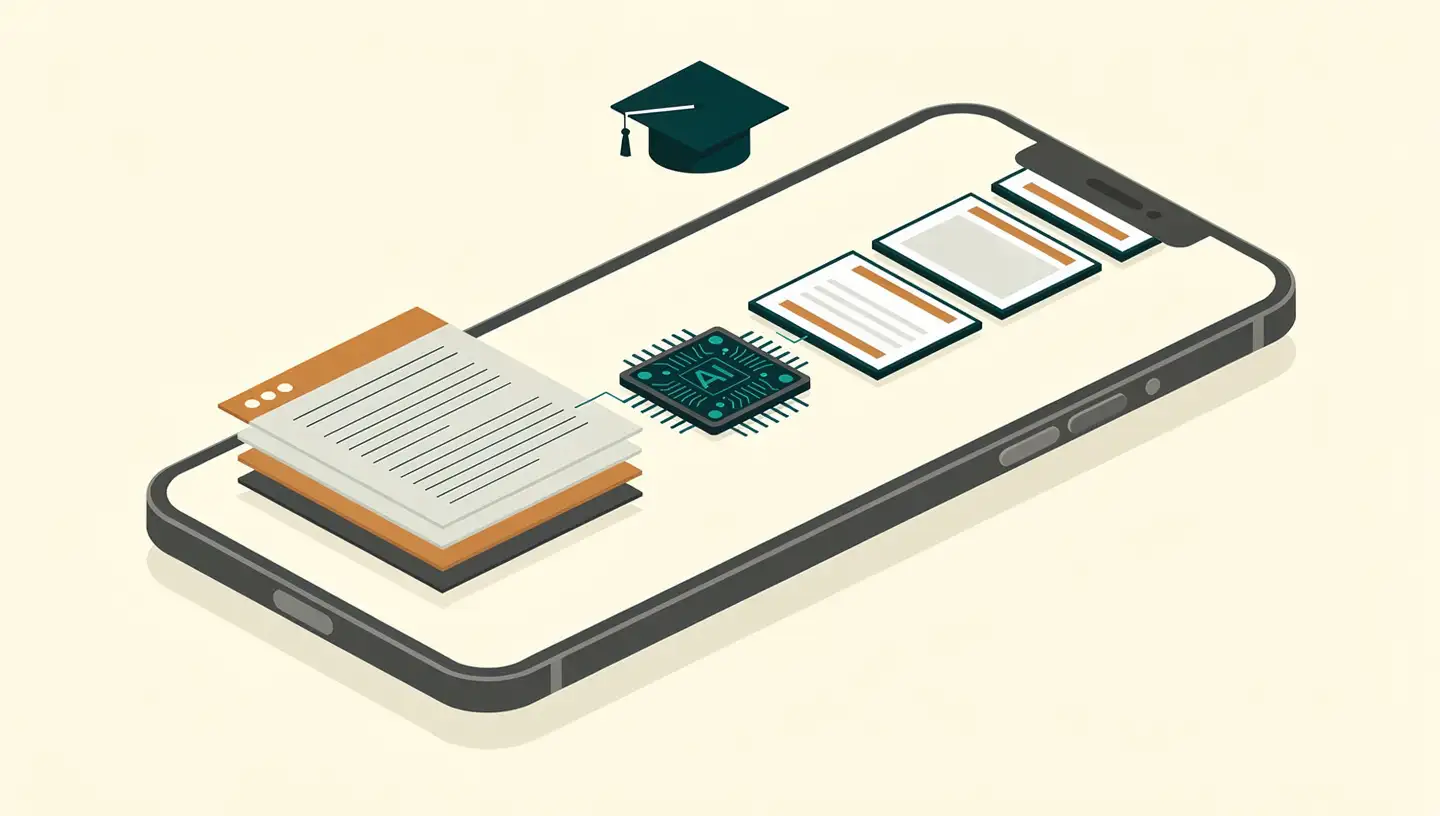
AI-generated image
What Is Active Recall? Why It Beats Re-Reading
Active recall is the deliberate practice of pulling information out of your memory rather than passively reviewing it. The mechanism is straightforward: each successful retrieval strengthens the neural pathways involved, making the information easier to recall next time. The Birmingham City University guidance puts it directly — active recall is one of the most effective study methods because it actively stimulates memory during study.
Three concrete formats dominate:
Flashcards — a question on one side, an answer on the other, with self-testing before flipping
Free recall — closing the book and writing everything you remember about a topic
Practice questions / quizzes — testing yourself against questions you haven't seen recently
Re-reading and highlighting feel productive but are passive — they engage recognition rather than retrieval, and recognition memory is much weaker than recall memory. Active recall is the higher-friction technique that produces durable learning. The friction is exactly the point.
The historical bottleneck wasn't the technique. It was the labour of building good flashcards or quiz questions from your own notes. That's where AI changes the workflow.
How AI Changes the Active Recall Workflow
AI doesn't replace active recall — it makes the preparation tractable. Three concrete shifts:
Question generation from your notes. Upload (or paste) your own notes and an AI model can produce flashcards and quiz questions from them automatically. One study workflow shared by a student reported cutting exam prep time from 4 hours to 30 minutes using AI to generate study materials — freeing time for actual recall practice rather than card-making busywork.
Source-material expansion. AI tools can ingest YouTube videos, lecture recordings, PDFs, and handwritten notes — turning passive consumption into active-recall material. For language learners specifically, Google Gemini with the Guided Learning tool can watch a comprehensible-input YouTube video and generate 10 questions in the target language about its content, plus a downloadable .csv of vocabulary and sentences ready to import into Anki. For the broader offline language-learning stack — including Apple's on-device Live Translation and Google AI Edge Gallery — see our offline language learning guide.
On-demand tutoring. When a question stumps you, the same AI that generated it can answer it — providing tutoring access faster than searching through a textbook.
Crucially, the AI never replaces the act of retrieval itself. You still do the recalling. The AI just makes the preparation step take minutes instead of hours.
The 2026 Mobile Study Stack: Apps and Models
The current ecosystem splits into purpose-built study apps and general-purpose local LLM runners.
Purpose-built study apps
Gizmo (AI Tutor) — utilises active recall and spaced repetition explicitly. Imports materials from Quizlet, Anki, YouTube, PDFs, Notes, and PowerPoint to create flashcards quickly. Scans handwritten notes and converts them into flashcards and quizzes. Access to over 1,000,000 pre-made flashcard decks created by other students. Gamified with quizzes and leaderboards.
Anki — the foundational spaced-repetition app for active recall. Designed for creating flashcards that you quiz yourself with on the go. Pairs naturally with AI tools that generate Anki-compatible .csv exports.
NotebookLM — upload notes or resources and have the system test you on the topic, supporting AI-driven active recall.
General-purpose local LLM apps
PocketPal AI — intuitive interface for interacting with small language models directly on smartphones, with offline access for drafting, brainstorming, or answering queries
AnywAIr (iOS) — runs AI models locally on iPhone with zero internet, ensuring complete privacy. Supports both MLX and Llama models, with multiple themes (Gradient, Hacker Terminal, Aqua, Typewriter)
llama.cpp — the foundational C/C++ inference framework that lets you run quantised models on smartphones with minimal setup
Models worth running on a phone
Phi-3-mini (Microsoft) — 3.8 billion parameters, available through Microsoft Azure, Hugging Face, and Ollama. Per Microsoft's VP of AI Luis Vargas, small language models can enable AI experiences on devices even in areas with poor network connectivity — including rural locations
Gemma 3 1B (Google) — runs up to 2,585 tokens per second on mobile GPU, processing a page of content in under a second
Llama 3.2-1B and SmolLM2-1.7B — optimised to operate on edge devices with lower energy consumption and faster inference, suitable for resource-constrained smartphones
For a deeper comparison of which model fits which phone tier, see our local LLM benchmark guide.
Why Local LLMs Matter for Studying
The case for running the study model on-device rather than via a cloud API has four parts:
Privacy. Notes you wrote about confidential work, sensitive medical topics, personal struggles, or proprietary research never leave your phone. Cloud-based study tools see every flashcard you generate.
Offline use. Local AI models work without internet — useful during flights, in remote locations, or in areas with poor connectivity. For students in libraries with patchy Wi-Fi or commutes through dead zones, this isn't theoretical; it's daily.
Cost. Running an open-source local model on a mobile device incurs minimal costs (primarily electricity), versus the subscription fees charged by cloud-based AI services. Active recall is a long-game habit; subscription compounding hurts.
Latency. Local processing avoids the network round-trip to a remote server, giving immediate responses — especially valuable for rapid-fire flashcard sessions where lag breaks rhythm.
How to Set It Up: A Practical Workflow
A working stack you can assemble today:
Step 1 — Capture your study material in any form. Lecture notes (text or photo), PDFs, YouTube lectures, voice recordings. AI tools can ingest most formats.
Step 2 — Generate the flashcards.
For text notes and PDFs: Gizmo or NotebookLM
For YouTube video lectures: Google Gemini with Guided Learning, which can produce questions and downloadable vocabulary CSVs
For your own raw notes: a local LLM (Phi-3-mini, Gemma 3 1B, or similar) running in PocketPal or AnywAIr, prompted with "Generate 15 flashcards from these notes"
Step 3 — Verify accuracy before committing. Spot-check 5–10 AI-generated cards against your source material. AI models hallucinate; wrong flashcards drilled through spaced repetition are worse than no flashcards. This step is non-negotiable for exam prep.
Step 4 — Drill in Anki or Gizmo. Both apps handle spaced repetition scheduling. Gizmo is more gamified; Anki is more austere and customisable. Either works for active recall.
Step 5 — Use the AI for on-demand tutoring. When a flashcard stumps you, ask the same local model to explain the concept. The model already has context about your study area from the original generation step.
For language learners specifically, the Google Gemini Guided Learning workflow — paste a YouTube URL, get 10 questions in your target language, export to Anki — is among the most effective uses of AI for active recall reported by self-learners.
Limitations and Trade-Offs
Local LLMs for studying are real and useful — but the trade-offs matter, especially for high-stakes exam prep.
Hallucination remains. Like all language models, local LLMs can confidently produce wrong answers. When studying for an exam, treat AI-generated flashcards as draft material that needs verification, not as a finished study guide.
Quantization accuracy trade-off. Running on mobile means using quantised models. The W4A16-INT quantization scheme (4-bit weights, 16-bit activations) is optimal for latency-critical applications and delivers approximately 3.5× model size compression with a 2.4× average speedup for single-stream scenarios — but quantization introduces some precision loss, particularly for complex reasoning tasks.
Battery and thermal. Running AI models on-device is computationally intensive. Sustained study sessions with continuous LLM inference will warm the phone noticeably and drain the battery faster than typical app usage. For long study sessions, keep the phone plugged in.
Smaller context windows. Mobile-optimised SLMs typically have smaller context windows than their cloud counterparts, which constrains how much material the model can process in one shot. Long PDFs or extensive notes may need chunking.
Storage requirements. A quantised study-grade model typically needs 2–4 GB of storage; higher-capability models can exceed 8 GB. On phones with tight storage, that's real space competing with photos and apps.
Hardware acceleration is improving. Qualcomm introduced the Qualcomm Matrix Extension (MX), a hardware matrix-multiplication acceleration capability integrated directly into its latest CPU architectures, which significantly improves LLM inference efficiency on platforms where GPU resources may be constrained. Benchmarked with llama.cpp on a Snapdragon 8 Elite Gen 5 Mobile platform, MX provides substantial improvements over conventional SIMD-only inference. Translation: the on-device study experience will get noticeably better as 2026 flagship Android phones reach more users.
Frequently Asked Questions
What is AI-powered active recall?
AI-powered active recall pairs the proven cognitive technique of actively retrieving information from memory — via flashcards or self-testing — with an AI model that generates the questions and grades responses. The student still does the retrieval (which is what builds memory); the AI removes the busywork of preparing materials, letting you spend more study time on the recall practice itself.
Which is the best AI app for active recall?
Gizmo is purpose-built for active recall and spaced repetition, with support for importing materials from Quizlet, Anki, YouTube, PDFs, Notes, and PowerPoint, plus handwritten-note scanning. Anki remains the gold-standard flashcard app and pairs well with AI-generated decks. NotebookLM lets you upload notes and tests you on them. For language learning, Google Gemini with Guided Learning works particularly well.
Can I do active recall studying offline on my phone?
Yes. Local LLMs run entirely on the device with no internet required. Apps like PocketPal AI on Android/iOS and AnywAIr on iPhone let you load models like Phi-3-mini, Gemma 3 1B, or Llama 3.2-1B locally. The model generates questions and grades responses entirely offline — useful for studying on planes, in remote areas, or anywhere with poor connectivity.
Which local LLM should I use for studying on a phone?
For most students, Phi-3-mini (3.8B parameters) offers the best capability for study tasks on a flagship phone. Gemma 3 1B is faster — up to 2,585 tokens per second on mobile GPU, processing a page in under a second — and lighter on RAM. Llama 3.2-1B and SmolLM2-1.7B are optimised specifically for edge devices, balancing accuracy with energy efficiency.
Are AI-generated flashcards accurate?
Usually yes, but verify. AI models can produce hallucinations — incorrect or misleading information presented confidently. When studying, especially for exams, spot-check AI-generated flashcards against your source material before committing them to spaced repetition. Wrong flashcards reinforced through active recall are worse than no flashcards at all.
Conclusion
Active recall has been the highest-ROI study technique cognitive scientists have studied for over a century. The change in 2026 is that the laborious part — building good flashcards and quiz questions from your own material — finally has a reliable shortcut. Gizmo, Anki with AI-generated decks, NotebookLM, and Google Gemini for video-based learning handle the question-generation side. PocketPal AI, AnywAIr, and llama.cpp handle the on-device model side. Phi-3-mini, Gemma 3 1B, and Llama 3.2-1B handle the inference.
The combination keeps the proven retrieval mechanism intact (you still do the active recalling) while taking the busywork out of preparation. For privacy-conscious students, for anyone who studies on a plane or in a coffee shop with weak Wi-Fi, and for anyone tired of paying $20/month for the same flashcards a local model produces for free — the on-device path is the new default.
Pick a study app you'll actually open. Pick a model that fits your phone. Spend the freed time on retrieval, not on making cards. That's the assignment.