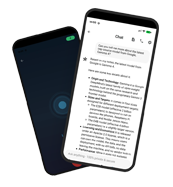
Your Private, Offline AI Assistant.
Take notes and chat with a smart AI agent directly on your Android device. No cloud, completely private, and 100% free.
download
Offline Language Learning: On-Device AI Apps & Models
Apple Intelligence's Live Translation runs entirely on-device, with eight more languages added by the end of 2025. Google's EmbeddingGemma needs under 200MB of RAM to power offline chatbots and translation. The whole stack of language learning — translation, conversation practice, vocabulary drills — has quietly moved off the cloud and onto the phone.
Quick Answer: Offline language learning means using AI tools that run entirely on your phone — no internet required for translation, conversation practice, or drills. The 2026 stack: Apple's Live Translation (built into Messages, FaceTime, Phone), Google AI Edge Gallery (Gemma 4 on-device), and apps like PocketPal AI for Small Language Model interaction. For dedicated language courses, LingoDeer supports full offline lessons; Duolingo offers partial offline. The hardware is here — Apple M5, modern Android NPUs — and model efficiency (EmbeddingGemma fits in under 200MB of RAM) makes the local stack practical.
Offline language learning with on-device AI is the use of AI models — typically Small Language Models (SLMs) or efficient embedding models — that run entirely on a user's smartphone, tablet, or computer, providing translation, conversation practice, and interactive drills without an internet connection or cloud server.
AI-generated image
What Counts as Offline Language Learning?
Two flavours of language learning rely on the network and shouldn't be confused with the on-device approach:
Fully online tools (Talkpal, Langua, Speak, Praktika) — sophisticated AI conversation partners, but each turn of dialogue requires a server round-trip
Hybrid tools (Duolingo, parts of Babbel) — work mostly online but allow some downloaded lesson content for offline use
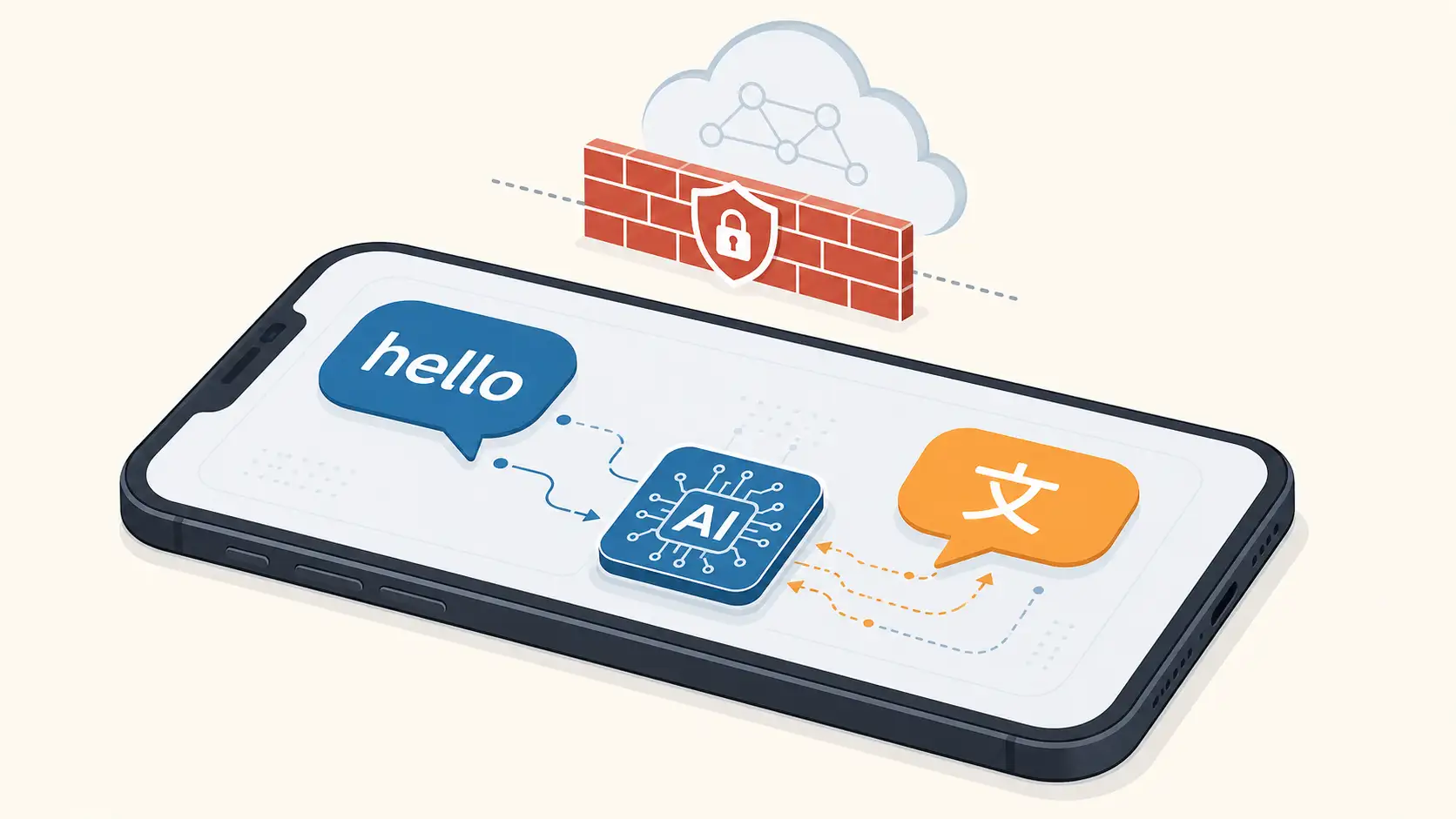
True offline language learning with on-device AI processes everything locally: the translation model, the conversational AI, the vocabulary drills, the pronunciation evaluation. Audio recordings, your typed responses, your mistakes — none of it traverses the network. The advantages are concrete: no data costs, no connectivity dependency, no third-party seeing your practice attempts.
The category is no longer aspirational. As of 2025, Apple ships on-device Live Translation as a system feature, Google ships the AI Edge Gallery with Gemma 4 running entirely locally, and developer-focused models like EmbeddingGemma fit in well under 200MB of RAM. The pieces are in place.
What Works Offline Today: A Stack-by-Stack Breakdown
AI-generated image
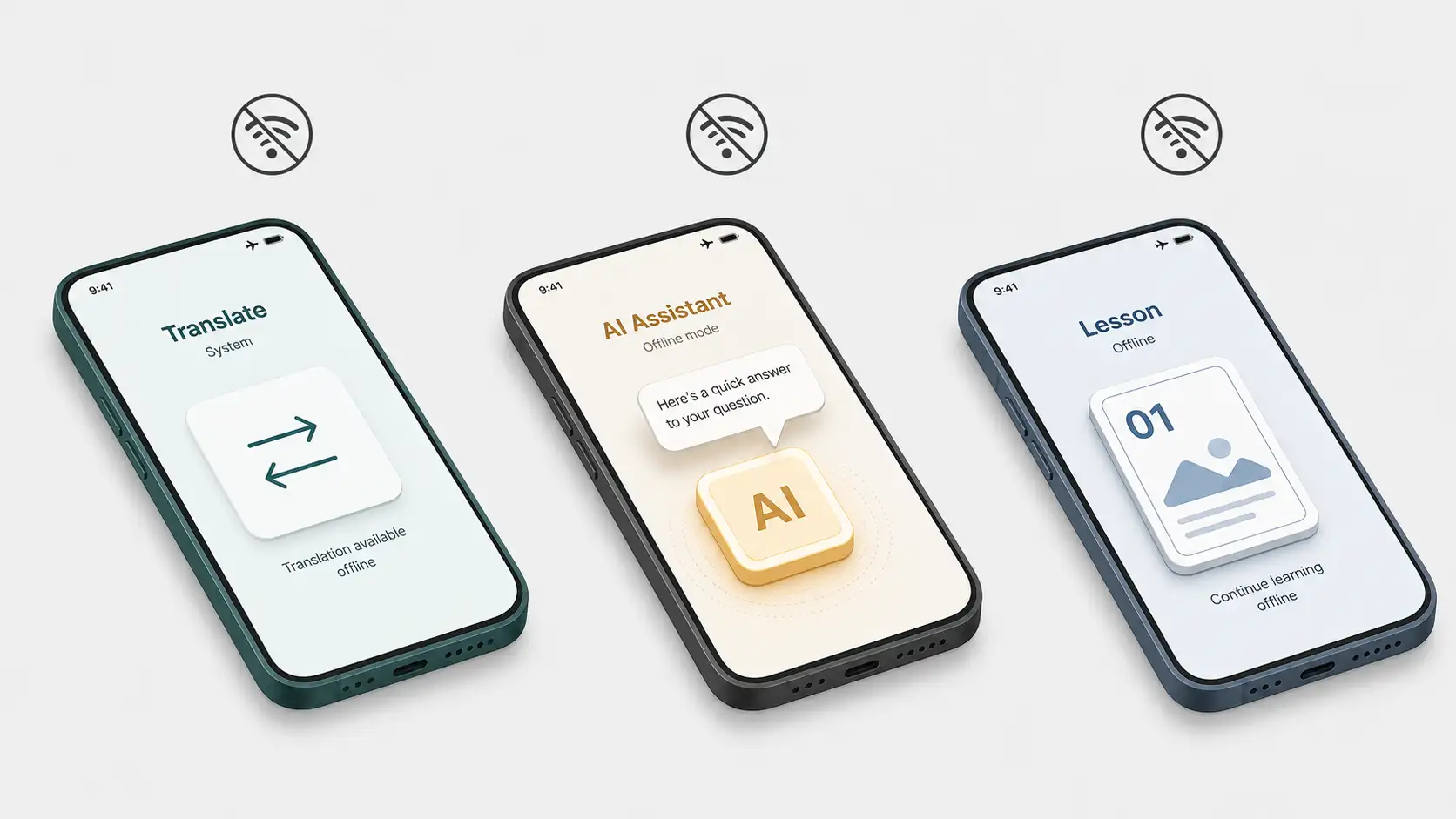
There are now three credible paths to offline AI-powered language learning, plus the established offline lesson apps that pre-date the AI wave.
Path 1: System-level translation (Apple Intelligence)
Apple's Live Translation, launched June 9, 2025, runs entirely on-device and integrates into Messages, FaceTime, and Phone calls. It can translate messages in real time — you type in your own language, the recipient sees theirs — without any data leaving the device. By the end of 2025, Apple expanded offline translation to eight additional languages: Danish, Dutch, Norwegian, Portuguese (Portugal), Swedish, Turkish, Chinese (Traditional), and Vietnamese. For iPhone/Mac users, this is the most frictionless offline translation option — it's built into the OS.
Path 2: Open-model apps (Google AI Edge Gallery, PocketPal AI)
Google AI Edge Gallery (iOS) runs powerful open-source LLMs directly on the device, offering offline generative AI for translation, conversation, and language-learning workflows. Its Audio Scribe feature transcribes and translates voice recordings into text in real time using on-device language models. Gemma 4, the latest model in the app, supports fluid multi-turn conversations — making it usable as an offline conversation partner.
PocketPal AI offers an intuitive interface for interacting with Small Language Models directly on smartphones. Users can practice vocabulary, brainstorm sentences, or get feedback on language structure entirely offline, drafting in any language the loaded model supports.
Path 3: Dedicated offline lessons (LingoDeer, Duolingo partial)
LingoDeer allows users to download lessons for full offline study — structured grammar, vocabulary, and listening exercises that work without any connection. Among the established language-learning apps, it has the most complete offline support.
Duolingo is the best free starting point for A1–A2 beginners, employing gamification to encourage consistency, though progress often stalls at intermediate stages. AI features in Duolingo Max are still seen as limited compared to dedicated AI conversation apps. In early 2025, Duolingo launched 148 new language courses using AI — a substantial expansion of the platform's reach.
Honourable mention: AI conversation apps (mostly online)
Several leading AI speaking apps as of April 2026 — Langua, Speak, Praktika — provide sophisticated conversation practice but require an internet connection. Langua is recognised as the best overall for conversation depth, voice quality, and vocabulary review, with immersive conversations that save full history. Speak focuses on structured daily practice for beginners. Praktika is the "Daily Teacher Avatar" — engaging animated avatars providing humorous, personal responses. For travellers without connectivity these aren't the answer, but for learners with reliable Wi-Fi the AI conversation depth is currently better than what runs offline.
For a deeper dive on the open-source AI runners that power Path 2, see our local LLM on phone benchmark guide.
Apple Intelligence Live Translation: Built In, Built Local
For iPhone, iPad, and Mac users, the easiest entry point to offline translation is the OS itself. Apple Intelligence's Live Translation, launched June 9, 2025, runs entirely on-device and is integrated directly into the Messages, FaceTime, and Phone apps. The translation works in both directions in real time: you type or speak in your language, the recipient hears or reads theirs.
The offline guarantee is what makes this consequential for language learners. There's no upload, no cloud round-trip, no service to fail. The eight languages added by end of 2025 (Danish, Dutch, Norwegian, Portuguese (Portugal), Swedish, Turkish, Chinese (Traditional), Vietnamese) extend coverage meaningfully beyond Apple's initial set.
The on-device approach has implications beyond just convenience. For travellers in countries with restrictive internet policies or expensive data, the entire translation function works without depending on any service that could be blocked, throttled, or charged-per-use. For broader Apple privacy context, see our chat with PDFs privately article on Apple Intelligence's overall design.
Google AI Edge Gallery and Gemma 4 for Language Learners
The Google-side counterpart is AI Edge Gallery (currently iOS, expanding). The app runs open-source LLMs entirely on-device, offering high-performance generative AI completely offline.
The features that matter for language learning:
Audio Scribe — transcribes and translates voice recordings into text in real time, using high-efficiency on-device language models. Practical for processing recorded conversations, lectures, or audio textbooks.
Gemma 4 conversation — the latest version supports advanced reasoning and multi-turn dialogue, making it a real offline conversation partner. Not as polished as Langua, but online-free.
Prompt Lab — a dedicated workspace for testing prompts and controlling model parameters, useful for learners who want to construct custom drills or grammar exercises.
Tool augmentation — interactive map integration and similar tools that aid spatial learning and context-rich translation without internet.
For developers and tinkerers, the documentation provided alongside Gemma 4 includes instructions for downloading, running, and fine-tuning models — making it the most extensible offline language stack available in 2026.
Small Language Models for Translation and Conversation
The technical foundation under all of this is the new generation of Small Language Models. They're not just smaller cloud models — they're purpose-built for edge deployment.
Llama 3.2-1B — optimised for edge devices, enabling translation and conversational AI on mobile. Llama 3.2 is the practical choice for low-RAM phones.
Phi-3.5-Mini-3.8B (Microsoft) — designed for reasoning and code generation, demonstrating that AI conversation partners can operate offline with meaningful reasoning capability.
EmbeddingGemma (Google, September 2025) — a new open embedding model that delivers best-in-class performance for its size, with under 200MB of RAM requirement and a 2K token context window. Generates embeddings directly on the device, enabling personalised chatbots and retrieval-augmented generation (RAG) for interactive language drills without internet. For more on how on-device RAG works, see our on-device RAG primer.
Gemma 4 — the latest Gemma generation, capable of fluid multi-turn conversation on consumer hardware.
The hardware ceiling is rising rapidly too. Apple's M5 chip features a 10-core GPU with a dedicated Neural Accelerator in each core, plus a 16-core Neural Engine and 153 GB/s unified memory bandwidth — enabling large language models to run locally for offline language learning applications. Modern Android NPUs (Qualcomm, MediaTek, Google Tensor) deliver similar capability. The constraint that limited offline AI a year ago — not enough silicon to run useful models — is no longer the binding factor on flagship hardware.
Comparison: Language Learning Apps by Offline Capability
AI-generated image
App | Offline | AI Features | Best For |
|---|---|---|---|
Apple Live Translation | Full offline | System-level translation | iPhone/Mac users — no setup |
Google AI Edge Gallery | Full offline | Gemma 4 conversation, Audio Scribe | Open-model experimentation |
PocketPal AI | Full offline | SLM interaction (Llama, Phi, etc.) | Translation, writing practice |
LingoDeer | Full offline | Structured lessons | Systematic A1–B1 learning |
Duolingo | Partial offline | Gamification + AI tutoring | A1–A2 free starting point |
Talkpal | Requires connection | Advanced AI conversation | Breaking the B1 plateau |
Langua | Requires connection | Immersive multi-day conversations | Conversation depth |
Speak | Requires connection | Structured daily practice | Complete beginners |
Praktika | Requires connection | Animated avatar teacher | Daily engagement |
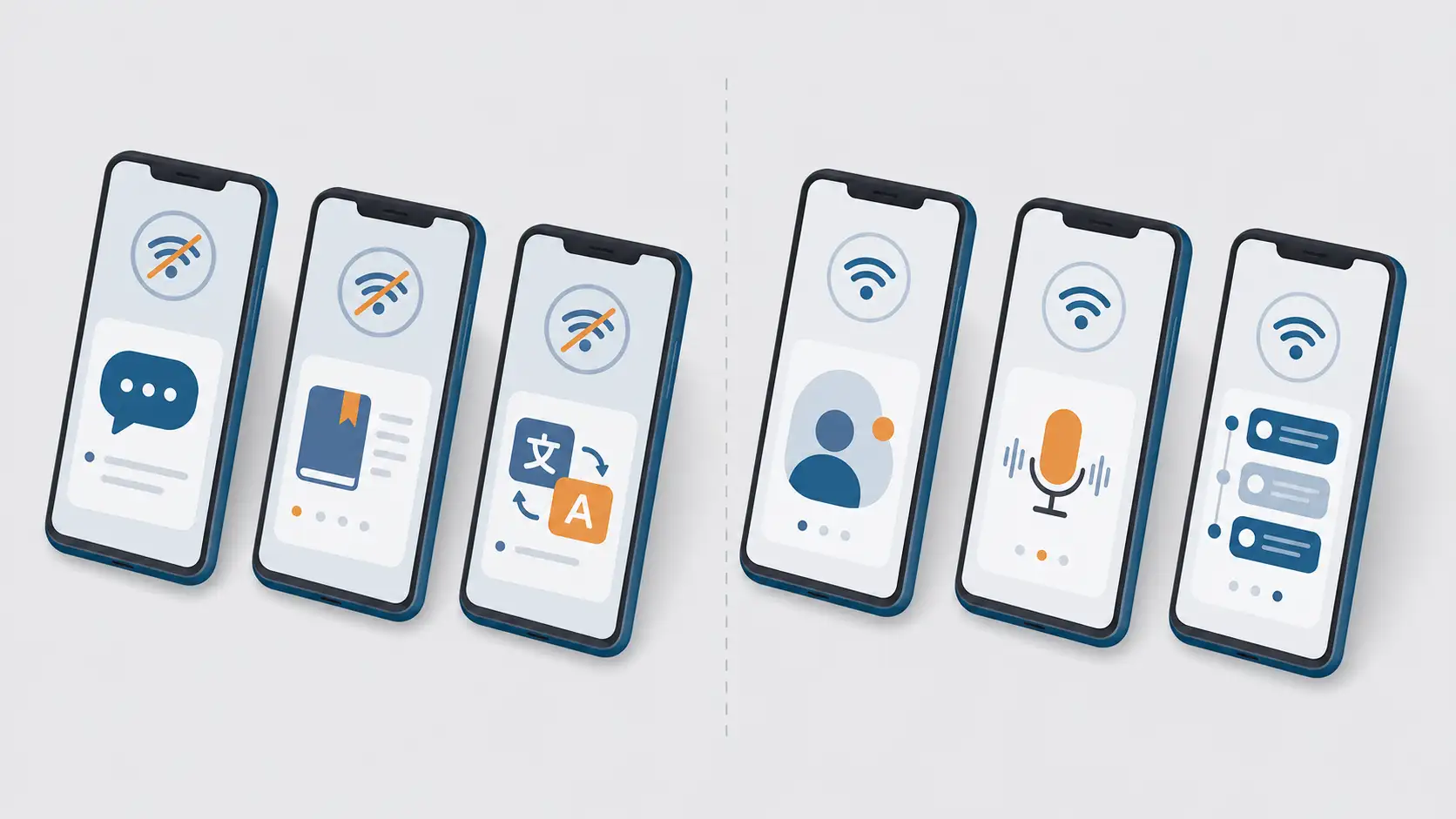
The pattern: dedicated AI conversation apps (Talkpal, Langua, Speak, Praktika) are currently the strongest for sustained dialogue practice but require an internet connection. For offline-only learning, the OS-level translation (Apple) and open-model apps (AI Edge Gallery, PocketPal) cover translation and basic conversation; LingoDeer covers structured lessons; Duolingo bridges both modes for casual beginners.
When Cloud Still Wins: Honest Trade-Offs
Offline AI language learning is genuinely useful, but it's not strictly better than online tools in every dimension.
Conversation depth. Apps like Langua and Talkpal currently offer richer multi-turn dialogue than on-device alternatives — they can leverage larger cloud models with more parameters and broader world knowledge. For a learner whose primary goal is conversation fluency, the cloud apps are likely still the better choice if connectivity is reliable.
Freshness. Online AI models benefit from continuous updates — new vocabulary, current idioms, recent cultural references. Offline models become stale over time and miss linguistic shifts unless explicitly updated by the user.
Hardware constraints on model complexity. Mobile hardware limits model size; even with quantization techniques, on-device models can produce less nuanced responses than cloud alternatives on complex tasks. The gap narrows every generation (Apple M5, the new Android NPUs) but doesn't disappear.
Social and collaborative features. Online platforms can offer real-time interaction with other learners or human tutors, live pronunciation feedback from native speakers, and integration with current events. These are categories offline-only models structurally can't replicate.
Limited real-time information. Offline models can't pull current events, recent news, or live-data examples. For learners who want their language input grounded in what's happening now, online tools fit better.
Where offline wins instead. Travellers in low-connectivity regions. Commuters. Privacy-conscious learners who don't want their practice recordings on someone else's server. Anyone in a country with restrictive internet policies. Anyone tired of paying $20/month subscriptions for tools that mostly do flashcards a local model could generate. For these use cases, the offline path isn't a fallback — it's the better choice.
Frequently Asked Questions
What is offline language learning with on-device AI?
Offline language learning with on-device AI uses AI models that run entirely on your phone or tablet — no internet required — to provide translation, conversation practice, and interactive drills. Small Language Models like Llama 3.2-1B and Phi-3.5-mini, plus embedding models like EmbeddingGemma, make the local-only stack practical on 2026 hardware.
Can Apple Intelligence translate offline?
Yes. Apple's Live Translation, launched June 2025, runs entirely on-device and integrates into Messages, FaceTime, and Phone calls. It can translate messages in real time, letting you type in your language while the recipient sees theirs. Apple expanded coverage to eight additional languages by end of 2025: Danish, Dutch, Norwegian, Portuguese (Portugal), Swedish, Turkish, Chinese (Traditional), and Vietnamese.
Which language learning apps work without internet?
LingoDeer supports full offline lesson downloads for systematic learning. PocketPal AI runs Small Language Models entirely on-device for translation and conversation. Google AI Edge Gallery runs Gemma 4 offline for multi-turn conversations and audio transcription. Apple Intelligence's Live Translation works in Messages, FaceTime, and Phone calls without internet. Duolingo offers limited offline support for downloaded lessons.
Which on-device AI model is best for translation?
Google's EmbeddingGemma is the leading 2026 embedding model — under 200MB RAM, 2K token context window, generates embeddings directly on device. For full conversation, Phi-3.5-Mini-3.8B handles reasoning and dialogue offline, and Llama 3.2-1B is optimised for edge deployment. Gemma 4 via Google AI Edge Gallery is the strongest open model for multi-turn conversation entirely on-device.
What are the limits of offline AI language learning?
Three main trade-offs: offline models may become stale on the latest vocabulary, idioms, and current events; mobile hardware constrains model size, sometimes producing less nuanced responses than cloud alternatives; and offline tools lack live collaboration, human-reviewed pronunciation feedback, and updated cultural content. For most personal learning, the privacy and accessibility advantages outweigh these limits.
Conclusion
The reason 2026 is a quietly important year for offline language learning is that the building blocks finally line up. Apple ships Live Translation as a system feature with eight new languages by end of 2025. Google ships AI Edge Gallery with Gemma 4 running locally on iPhone. PocketPal AI gives Android and iOS users a friendly interface to small models like Llama 3.2-1B and Phi-3.5-mini. EmbeddingGemma fits under 200MB of RAM and powers personalized chatbots and RAG-driven drills entirely on-device. Apple's M5 chip and modern Android NPUs make all of it run fast enough to be useful.
For learners whose lives include flights, commutes, remote travel, weak Wi-Fi, expensive data, or any reason to keep their practice off vendor servers, the offline-first path is now genuinely competitive with the online apps — and superior in privacy and accessibility. The conversation-depth gap with cloud apps like Langua and Talkpal remains real, but it shrinks every model generation.
The fastest way to start: try Apple's Live Translation if you're on iPhone (no setup), Google AI Edge Gallery for a Gemma 4 conversation partner, or PocketPal AI if you want to experiment with smaller models. Pair any of these with LingoDeer's offline lessons or your existing flashcard stack, and you have a serious language-learning workflow that doesn't need the cloud to function.