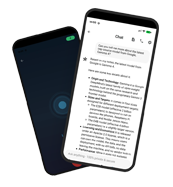
Your Private, Offline AI Assistant.
Take notes and chat with a smart AI agent directly on your Android device. No cloud, completely private, and 100% free.
download
On-Device RAG on Android: Private Document Querying
EmbeddingGemma — Google's open embedding model released September 4, 2025 — fits in under 200MB of RAM and produces document embeddings in under 15 milliseconds for 256 input tokens. That puts the foundation for fully-private RAG (Retrieval-Augmented Generation) on Android within reach: AI-powered document querying that never transmits a single byte to the cloud.
Quick Answer: On-device RAG on Android lets users search and query their documents using AI — without sending data to a cloud server. The 2026 stack: EmbeddingGemma (308M parameters, under 200MB RAM, under 15ms inference) for document embeddings; Gemini Nano or Gemma 4 for the language model; AppSearch or a local vector store for indexing; and ML Kit GenAI APIs to wire it together. Research systems already achieve 94.5%+ accuracy with sub-4-second response times, entirely offline.
Retrieval-Augmented Generation (RAG) is an AI technique that optimises a language model's output by referencing an authoritative knowledge base outside its training data — retrieving relevant content first, then generating a response grounded in that content. On-device RAG runs that entire pipeline locally on the user's Android device, so no document ever leaves the phone.

AI-generated image
What Is On-Device RAG? Retrieval, Generation, Privacy
RAG addresses a structural weakness of language models: their training data is fixed. By retrieving fresh, authoritative content before generation, the model can ground its answer in current and verifiable information. RAG also enhances user trust by allowing the language model to present accurate information with source attribution, including citations or references to source documents.
The same RAG technique that grounds cloud AI in fresh information can be run entirely on the user's device — and that changes the privacy story completely. With RAG, developers can control and change the language model's information sources to adapt to changing requirements, restrict sensitive information retrieval according to authorization levels, and troubleshoot incorrect references. This level of control is structurally easier when the entire pipeline runs locally — the application has complete sovereignty over how information is stored, retrieved, and processed.
The pipeline has two halves:
Retrieval — the user's query is converted to a vector embedding and compared against pre-computed embeddings of the user's documents to find the closest matches
Generation — the retrieved context is passed to a language model, which generates a natural-language answer grounded in the actual document content
When both halves run on-device, sensitive documents (medical, financial, legal, personal) never traverse a network. The result is RAG without the typical privacy compromise.
How an On-Device RAG Pipeline Works on Android
When building a RAG pipeline using EmbeddingGemma, the retrieval step involves generating the embedding of a user's prompt and calculating the similarity with the embeddings of all the documents on the system — allowing accurate, privacy-preserving responses to document queries.
End-to-end on Android, this means:
Indexing (one-time / on update) — the user's documents are processed locally; each chunk is converted to a vector embedding using EmbeddingGemma; embeddings are stored in a local vector store or AppSearch index.
Query embedding — when the user enters a question, EmbeddingGemma converts the query to a vector in the same embedding space.
Similarity search — the local index returns the top-k most semantically similar document chunks.
Generation — Gemini Nano (via ML Kit GenAI APIs) or another on-device LLM receives the retrieved chunks plus the original query and generates a grounded answer, with source attribution back to the original documents.
Every step runs locally. The only thing that ever leaves the device — if the developer chooses to allow it — is the model weights download itself, before any user data is processed.
The 2026 On-Device RAG Stack for Android
Building blocks available on Android as of 2026:
Layer | Technology | What it provides |
|---|---|---|
Embedding model | EmbeddingGemma | 308M parameters, under 200MB RAM, under 15ms per 256 tokens, offline |
Generation model | Gemini Nano / Gemma 4 | Local LLM with reasoning, available through ML Kit GenAI APIs |
Indexing & search | AppSearch | High-performance on-device search; multi-language; LocalStorage / PlatformStorage / PlayServicesStorage |
ML utilities | ML Kit | On-device text recognition, OCR, language ID, translation — all local |
Orchestration | Google AI Edge | On-device RAG support introduced May 20, 2025 — augment SLMs with app-specific data without fine-tuning |
Notes on each:
EmbeddingGemma — designed specifically for on-device AI, delivering private, high-quality embeddings that work offline. Built for performance: under 15ms inference for 256 input tokens, suitable for real-time RAG responses. Allows searching through personal files, texts, emails, and notifications without internet.
Gemini Nano — lets you run inference directly on Android, with ML Kit GenAI APIs for out-of-the-box solutions. Google Pixel's voice recorder uses Gemini Nano for offline summary generation; TalkBack uses it for image descriptions; Kakao Mobility used it to streamline address entry and reduce order completion time by 24%.
Gemma 4 — an open model that unlocks local agentic intelligence on Android. Build on-device AI features using ML Kit GenAI APIs to enhance privacy by processing data without cloud involvement.
AppSearch — a high-performance on-device search solution for managing locally stored structured data, with full-text search APIs. Supports multi-language (English, Spanish, and more). Three storage options let applications manage data privately or in a system-wide central index. Results are ordered by score and ranking strategy, with no cloud transmission.
ML Kit — production-ready, mobile-optimised solutions for common machine-learning tasks that run on-device. Features include text recognition (OCR), language identification, translation, barcode scanning, and real-time object tracking — all without sending data to the cloud.
For the generation model itself — picking a small LLM that fits your phone's RAM and NPU budget — see our local LLM on phone benchmark guide. For background on what NPUs actually do, the Neural Processing Unit explainer covers the hardware side.
Real-World Implementations and Accuracy
On-device RAG is not just a research idea. It's running today, at production-quality accuracy.
Pocket RAG — a research system that runs directly on Android, designed for offline first-aid guidance in disaster scenarios where connectivity is lost. The published numbers: 94.5% accuracy for physical first aid guidance and 97.0% for psychological first aid. Latency reduction techniques cut response time from 14.2 seconds to 3.7 seconds — nearly 4× faster — which matters for time-sensitive use cases.
PrivacyAssist — a multi-agent LLM-based platform that uses on-device RAG to provide real-time warnings and explanations about Android app permissions and data practices. In an evaluation involving 200 users and 2,347 Android apps, only 16% of apps were fully consistent between the permissions users granted and the data practices the developers declared. PrivacyAssist surfaces those gaps on the device, before installation.
Kakao Mobility — implemented Gemini Nano for address entry; order completion time dropped 24% and server costs decreased because the work moved on-device.
The pattern across implementations is consistent: on-device RAG delivers production-grade accuracy and latency, and the privacy story comes for free.
Apps and Tools That Already Deliver On-Device RAG
The on-device RAG ecosystem on Android has grown substantially.
Pocket LLM — an Android application offering fully on-device local LLM chat, voice input, image input, OCR, and camera-based prompting. After the initial model download, no data leaves the device. Supports document intelligence with RAG, persistent local chat history, hybrid retrieval, and uses ONNX and LiteRT backend for high-performance inference.
InferrLM — runs AI language models directly on iOS/Android devices with no internet required. Features RAG for document understanding and built-in OCR for extracting text from photos and PDFs. All chats and data remain on the user's phone.
PrivateGPT — a production-ready RAG project that lets users query documents using LLMs with no data leaving the execution environment. First released in May 2023, designed for privacy-sensitive setups. The high-level API abstracts document ingestion, parsing, metadata extraction, and embedding generation. Used for secure enterprise deployments without external cloud dependencies, particularly in regulated industries like healthcare and finance.
LM Studio — runs LLMs locally without sending any data to external servers. Supports a variety of model formats and parameter customisation (temperature, context length). Local LLM tools like LM Studio prevent user data from being shared for training purposes.
For developers building from primitives, the Android Developers documentation and Google AI Edge provide the official path: ML Kit GenAI APIs, Gemini Nano integration, and the May 2025 on-device RAG support for small language models augmented with app-specific data. To wire RAG into a full personal knowledge base on the device, see our private brain on Android guide, which combines local storage, on-device inference, and the RAG layer covered here.
Privacy and Security Trade-Offs
On-device RAG eliminates the transit-time privacy risk entirely. Sensitive documents and queries never traverse a network. For users handling medical records, financial documents, legal correspondence, or proprietary work files, that property alone justifies the architecture.
But the privacy story is not binary. Academic research on RAG systems highlights that RAG can handle sensitive health information (SHI), including protected health information (PHI), across multiple architectural components like indexers and vector stores — and the incorporation of retrieval mechanisms into LLM pipelines fundamentally reshapes the privacy risk surface. The conclusion: robust privacy protection measures are needed regardless of whether the pipeline runs in the cloud or on-device.
The shape of the risk shifts:
Cloud RAG centralises risk: providers maintain enterprise-grade physical security and compliance frameworks, but every query and retrieved context crosses the network and sits in the provider's environment.
On-device RAG distributes risk: data never traverses the network, but device compromise (theft, loss, malware) becomes the relevant threat. Encryption-at-rest and device-level access controls become essential.
For most personal and many enterprise use cases, on-device RAG materially improves the privacy posture. For very large enterprise deployments where centralised compliance auditing and key management are dealbreakers, hybrid approaches remain viable.
Limitations and Engineering Considerations
On-device RAG is real and useful, but it has trade-offs developers need to plan for.
Model capability ceiling. Cloud-based RAG can use much larger language models — tens or hundreds of billions of parameters — with broader world knowledge. On-device models must be optimised for mobile hardware, which typically means smaller parameter counts. For tasks requiring access to vast, continuously updated public knowledge bases, cloud RAG can still produce better answers. For personal document querying, on-device models are already plenty capable.
Mobile hardware constraints. Embedding generation and inference require substantial RAM and CPU. EmbeddingGemma's efficient design uses approximately 308 million parameters and runs in under 200MB of RAM, but on lower-end devices, response times slow and large document collections become harder to handle. Continuous on-device AI processing also affects battery life.
Indexing overhead. Building the initial index for hundreds or thousands of documents requires upfront computation. Users may experience a noticeable delay on first setup or when adding large new document sets.
Enterprise deployment complexity. When sensitive documents and embeddings live on each device, organisations face new operational challenges: secure key distribution across thousands of devices, key rotation policies, recovery for lost/stolen devices, and consistent security-patch levels across diverse hardware. Cloud architectures handle these centrally.
When cloud-based RAG may still fit better:
Enterprises needing centralised logging, compliance auditing, and admin control over data across users
Applications that genuinely need to aggregate or share knowledge bases across users or devices
Use cases requiring maximum AI capability over privacy guarantees, with already-established trust in cloud providers
Frequently Asked Questions
What is on-device RAG and how does it work?
On-device RAG (Retrieval-Augmented Generation) runs the full retrieval-and-generation pipeline locally on the user's Android device. The app generates embeddings of documents and the user's query, finds the closest matches, and feeds them to a local language model to produce a grounded answer — without sending any data to a cloud server.
Which models can I use for on-device RAG on Android?
For embeddings, Google's EmbeddingGemma (308M parameters, under 200MB RAM, under 15ms per 256 tokens) is the leading 2026 choice. For generation, Gemini Nano with ML Kit GenAI APIs and Gemma 4 work natively on Android. Local LLMs like Qwen and LLaMA also run via Pocket LLM, llama.cpp, and similar frameworks.
Is on-device RAG more private than cloud RAG?
Yes. On-device RAG processes all queries and document embeddings locally, so sensitive data never leaves the user's device. Cloud RAG transmits queries and retrieved context to remote servers, which expands the privacy risk surface. The trade-off: cloud providers offer compliance frameworks and audits that individual organisations cannot easily replicate on-device.
How accurate is on-device RAG compared to cloud-based RAG?
On-device RAG is highly capable. The Pocket RAG research system achieved 94.5% accuracy for physical first aid guidance and 97.0% for psychological first aid — entirely offline. Cloud RAG can leverage larger models and broader knowledge bases for complex queries, but for personal document querying, on-device RAG accuracy is already production-ready.
What are the main limitations of on-device RAG?
Three constraints: mobile RAM and compute limit model size; battery drain and thermal throttling during sustained sessions; and indexing large document libraries can take significant upfront time. Enterprise deployments also face key management and device-fleet update complexity that cloud architectures handle centrally.
Conclusion
On-device RAG on Android in 2026 is no longer a research-only architecture. EmbeddingGemma gives developers a 308M-parameter embedding model that runs in under 200MB of RAM with sub-15ms inference. Gemini Nano and Gemma 4 give them the language model. AppSearch and ML Kit give them the indexing and utility primitives. Google AI Edge ties it all together with native on-device RAG support.
Published research systems like Pocket RAG show production-grade accuracy (94.5%+ in their domain) with sub-4-second response times — entirely offline. Real apps — Pocket LLM, InferrLM, PrivateGPT, LM Studio — already give users on-device RAG today. The technology is here; the question is which workloads will adopt it first.
For developers building privacy-sensitive document search, on-device RAG is now a default option, not a research curiosity. For users handling medical, financial, or legal documents, it's the cleanest answer to a long-standing tension: useful AI search, without compromising on where your data lives.