Your Private, Offline AI Assistant.
Take notes and chat with a smart AI agent directly on your Android device. No cloud, completely private, and 100% free.
download
AI Health Apps and Wearables: Privacy, Bias, and Safety
Across 177 peer-reviewed studies, AI symptom checkers correctly identified the primary diagnosis between 19% and 37.9% of the time. At the optimistic end of that range, the tool still misses the diagnosis in six out of ten cases. These tools are already embedded in everyday smartphones and wearables — and most operate without formal regulatory classification as medical devices.
TL;DR: AI-powered health apps and wearables offer real benefits for continuous monitoring and early detection, but carry documented risks: diagnostic accuracy can fall below 20%, health data is routinely shared with third parties without meaningful consent, and AI models can perform significantly worse for people of color and economically disadvantaged groups. Treat any AI health tool as a first filter, not a final answer.
AI-powered personal health devices are smartphones, smartwatches, fitness trackers, and dedicated medical devices that use machine learning algorithms to collect, analyze, and interpret health-related data — detecting patterns, providing insights, and offering preliminary health assessments directly to users.
AI-generated image
How Widely AI Health Technology Is Already Deployed
The adoption of AI in healthcare is not a future projection. In 2024, 71% of hospitals reported using predictive AI integrated with electronic health records, up from 66% in 2023. Hospitals' use of predictive AI for billing and scheduling facilitation saw increases of 25 and 16 percentage points respectively in a single year.
On the consumer side, wearable digital health devices have become ubiquitous, monitoring heart rate, activity levels, and sleep patterns in real time. The FDA has authorized a growing list of sensor-based digital health technology (sDHT) medical devices — including wearables designed for continuous or spot-check monitoring that can be used in non-clinical home settings. The integration of AI and machine learning into wearable sensor technologies has enabled continuous monitoring, personalised interventions, and predictive analytics at a scale previously limited to clinical environments.
Privacy Risks: Who Controls Your Health Data?
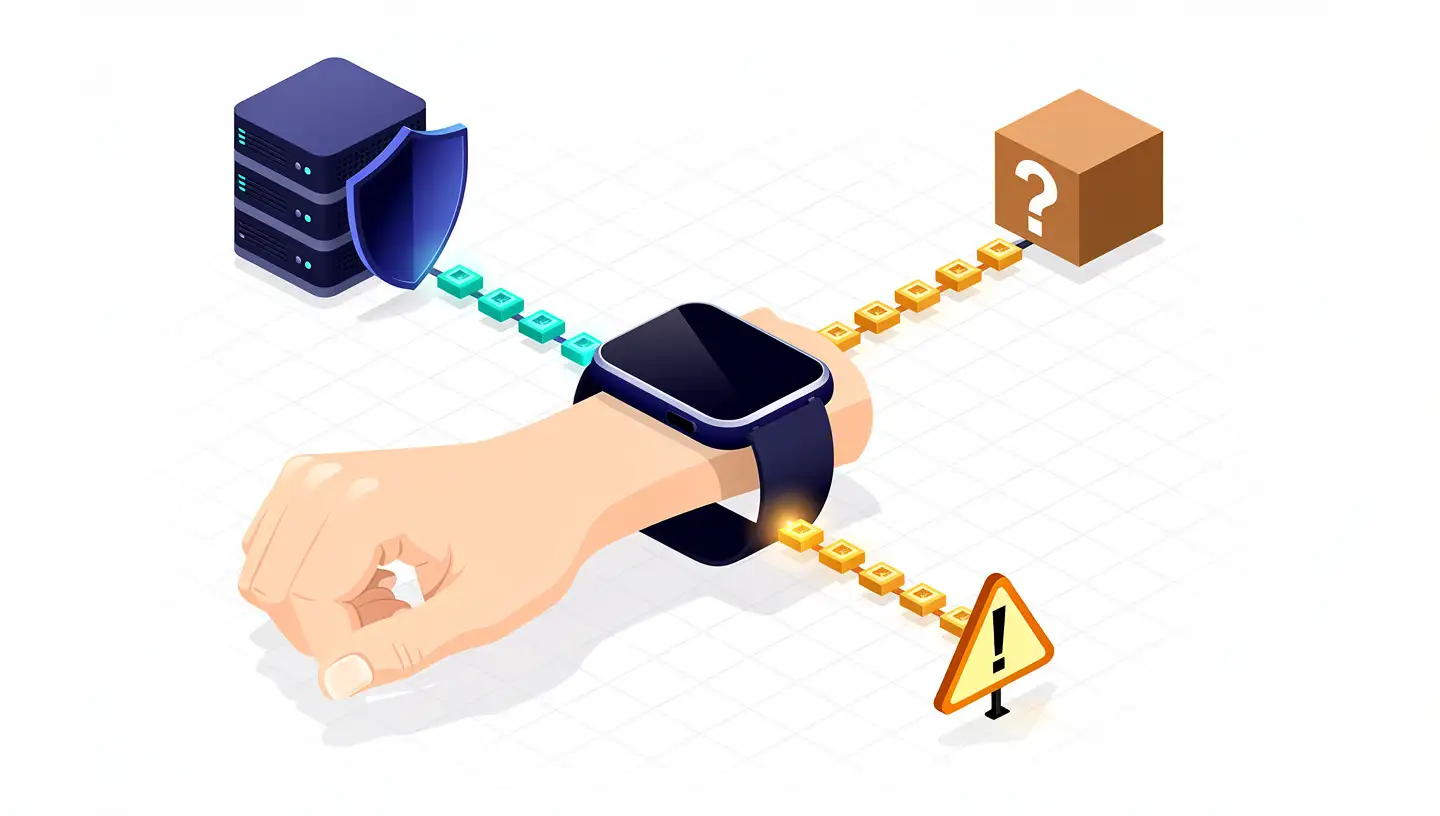
Health data is among the most sensitive personal information in existence — and it is routinely collected, stored, and transferred by private entities with limited oversight.
One of the main ethical concerns with wearable health technology is the unauthorized collection and storage of personal health data, which is often shared with third-party apps and services without the individual's knowledge or consent. The risk extends beyond unauthorized sharing: algorithms can re-identify individuals from supposedly de-identified data, increasing privacy risk under private custodianship. Recent public–private partnerships for implementing AI in healthcare have led to inadequate privacy protections, highlighting the need for greater systemic oversight.
Two documented cases illustrate how quickly health data exposure escalates:
Strava (2018): The fitness tracking app unintentionally revealed the locations of military bases and personnel through aggregated fitness tracking data — a privacy failure with national security consequences.
Fitbit (2011): The company faced a class-action lawsuit for allegedly selling personal health data to third-party advertisers without user consent.
The erosion of doctor-patient confidentiality compounds these risks. AI health apps that share data beyond medical professionals can affect health insurance premiums and personal relationships — consequences users rarely anticipate when granting app permissions.
Algorithmic Bias and Health Equity
AI models trained on wearable sensor data can produce significantly worse outcomes for underrepresented groups, exposing vulnerabilities in both technical design and ethical governance.
Without trustworthy and representative training datasets, AI algorithms embed biases that lead to discriminatory outcomes. A clinical decision-support model trained primarily on data from white patients yields less accurate results for people of color. The misuse or unethical application of AI can further exacerbate adverse outcomes for socially and economically disadvantaged populations — the groups that most need reliable healthcare.
The problem is structural: 76% of passive sensing studies for mental health monitoring relied on single-device methodologies, raising questions about whether findings generalize across devices, populations, or contexts. Only 14% of those studies reported on data anonymization practices. Addressing algorithmic bias requires community engagement, inclusive data practices, and transparent algorithms — measures that remain the exception rather than the standard.
Informed Consent: A Broken Promise
Informed consent for AI health applications is far more complex than a checkbox at app setup. AI complicates consent by raising questions about whether providers are obligated to inform patients about the type of machine learning used, the training data, and potential biases inherent in the dataset.
The challenge is structural. "Black-box" algorithms reach conclusions in ways that even their developers cannot fully explain — making meaningful explanation to patients nearly impossible. AI and ML models trained on wearable sensor data can lead to invasive profiling without explicit consent, with consequences including targeted advertising based on health data or increased insurance premiums.
Current regulations provide a baseline but leave critical gaps. GDPR requires explicit consent for data processing and includes provisions covering automated decision-making; HIPAA establishes baseline protections for health information in clinical contexts. However, neither was designed for AI-powered consumer health apps that collect health data outside traditional healthcare settings — creating ambiguity about what consent is actually required.
Regulatory mechanisms in healthcare AI are currently lagging behind technological developments, indicating a need for regulations that emphasize patient agency, meaningful consent, and sophisticated data anonymization methods.
Accuracy and Patient Safety: The Numbers
The accuracy data for AI health tools varies dramatically by task type.
Tool Type | Diagnostic Accuracy | Triage Accuracy |
|---|---|---|
AI Symptom Checkers (SAAs) | 19%–37.9% | 48.8%–90.1% |
Large Language Models (self-triage) | — | 57.8%–76.0% |
ML passive sensing (mental health) | Promising — limited external validation | — |
The wide triage accuracy range for symptom checkers suggests these tools are more useful for directing patients toward appropriate care levels than for identifying specific diagnoses. LLMs used for self-triage show moderate reliability at 57.8%–76.0% — better than the worst symptom checkers, but still well below what clinical decision-making requires.
The stakes are highest where these tools fail. High false negative rates in symptom checkers can lead to dangerous false reassurance — particularly for conditions like cardiac ischaemia and meningitis, where delayed care is life-threatening. The Babylon Diagnostic and Triage System claimed to outperform the average human doctor on a subset of a Royal College of General Practitioners exam — a claim that faced significant skepticism due to methodological issues that left any performance improvement over traditional symptom checkers unproven.
For mental health monitoring via passive sensing, ML models show promising accuracy for detecting anxiety, but only 2% of studies include external validation — a gap that poses significant challenges for clinical translation.
The Regulatory Gap
The regulatory landscape for AI health technology is fragmented. The FDA regulates sensor-based digital health technology that meets the threshold for medical device classification — including wearables authorized for continuous or home monitoring. But many consumer health apps and symptom checkers fall outside this classification entirely, creating a two-tier system where the most widely used tools face the least oversight.
Researchers have called for urgent guidelines on the evaluation of computerised diagnostic decision support systems directed at patients, to ensure safety, effectiveness, and appropriate regulatory oversight. Similarly, an urgent assessment of how digital symptom checker systems are regulated within health systems is needed, given the documented risks of inaccurate triage advice.
Key ethical requirements — informed consent, algorithmic fairness, and robust data protection — need to be embedded in the AI development process from the start, not added as compliance afterthoughts. The framework that best addresses this embeds transparency, accountability, and regulatory alignment across all stages of development, including explainable AI, bias mitigation techniques, and consent-aware data pipelines.
What These Devices Get Right
Despite the documented risks, AI-powered health devices provide genuine clinical value. Continuous monitoring can detect irregular heart rhythms, enabling intervention before symptoms appear. AI tools in hospital settings have meaningfully improved billing efficiency and scheduling, freeing clinical time for patient care. Passive sensing can surface early signals of mental health deterioration that self-reporting consistently misses.
Implementing strategies to promote health equity and the ethical use of AI can enhance trust and effectiveness in public health interventions for all populations. The goal is not to abandon these technologies — it is to hold them to the same evidentiary standard as any other clinical intervention.
On-Device AI for GDPR Compliance: Data Minimization
How on-device AI helps organisations meet GDPR's data minimization requirement by processing personal data locally — with real Apple, Google, and edge examples.
On-Device AI and GDPR: Achieving Data Minimization
On-device AI satisfies GDPR data minimization by keeping personal data on the device. Real examples from healthcare, financial services, and enterprise software.
Frequently Asked Questions
How accurate are AI symptom checkers?
Across 177 published studies, AI symptom checkers correctly identified the primary diagnosis 19%–37.9% of the time. Triage accuracy — directing users to the right care setting — is higher (48.8%–90.1%). Use them as a first filter, not a diagnosis.
What health data do wearables collect and who gets it?
Wearables typically collect heart rate, activity levels, sleep patterns, and sometimes ECG or blood oxygen data. This data is often shared with third-party services without clear user consent, and re-identification from de-identified datasets is a documented risk.
Are AI health apps regulated by the FDA?
Only some. The FDA authorizes specific sensor-based digital health devices that meet medical device classification thresholds. Most consumer health apps and symptom checkers fall outside FDA oversight, leaving a significant regulatory gap.
Can AI health apps be biased against certain groups?
Yes. Models trained on non-representative datasets produce worse outcomes for underrepresented demographic groups. Clinical decision-support tools trained primarily on white-patient data have shown lower accuracy for people of color.
How can I protect my health data when using AI health apps?
Review privacy policies for third-party data sharing, limit app permissions to what is genuinely necessary, prefer tools that process data locally on-device, and check for FDA clearance before relying on any AI tool for actual health decisions.
Conclusion
AI-powered health apps and wearables are already part of how people monitor their health — and that integration will deepen. The opportunity is genuine: continuous passive monitoring can catch what annual check-ups miss, and AI-assisted triage can direct patients toward appropriate care faster.
But the ethical gaps are equally genuine. Diagnostic accuracy below 20% in some tools. Health data shared without meaningful consent. Models that underserve the populations that most need reliable healthcare. Regulations that cover only the top tier of these devices while the most widely used apps face none.
If you use these tools, treat them as a first filter, not a final answer. Verify any AI-generated health guidance with a qualified clinician — especially before acting on a result that concerns you.
Use local-AI for health journaling: If you keep a digital diary of your symptoms, medications, or mental health progress, avoid standard cloud-based note-taking apps. Instead, use applications like Private Notes App, which utilize on-device AI. This allows you to securely organize and summarize your personal health logs locally, guaranteeing your sensitive medical data never touches a third-party server.