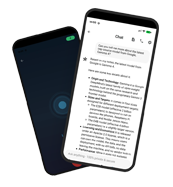
Your Private, Offline AI Assistant.
Take notes and chat with a smart AI agent directly on your Android device. No cloud, completely private, and 100% free.
download
On-Device AI and GDPR: Achieving Data Minimization
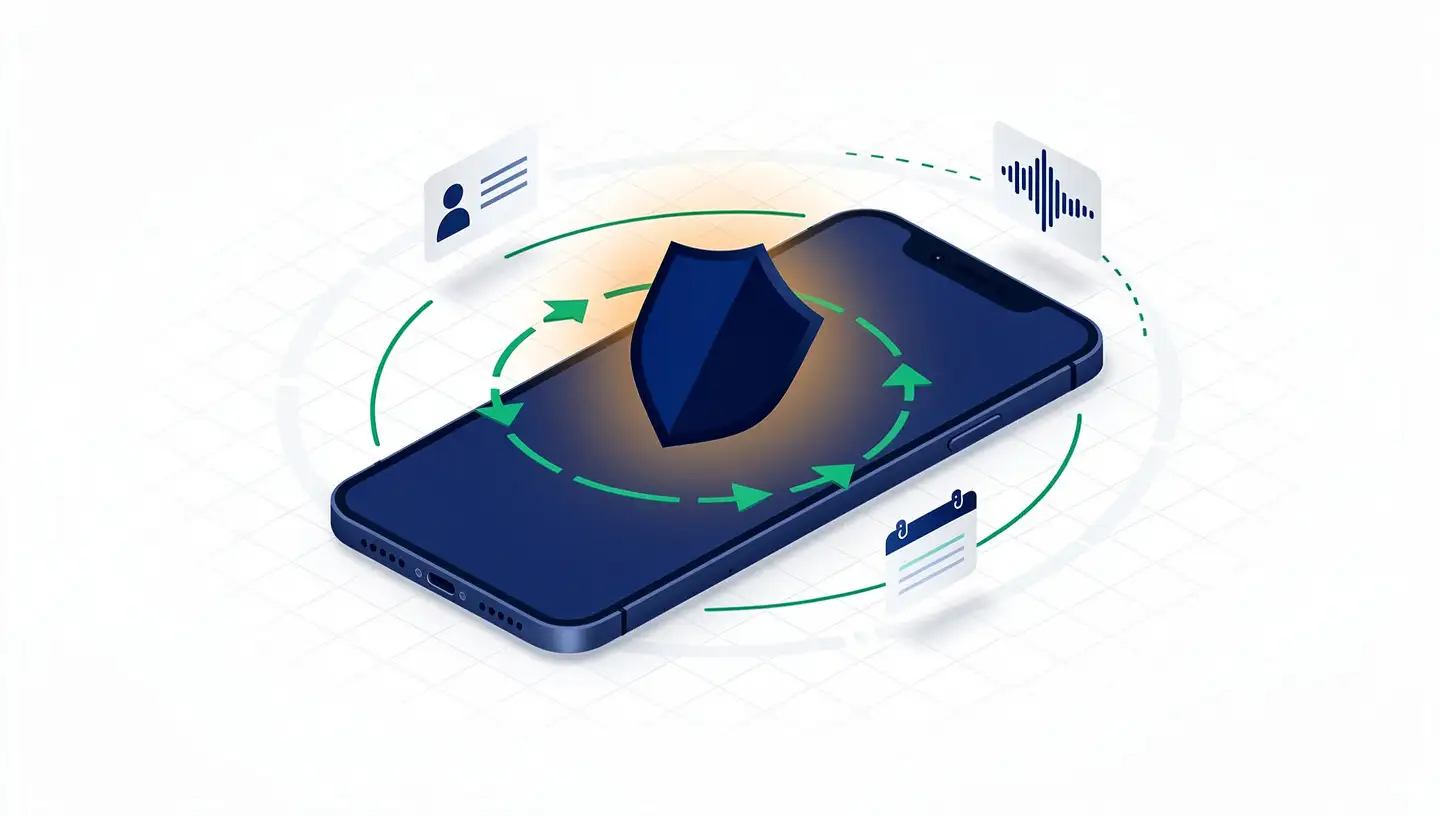
Every voice query, predictive keystroke, and facial unlock sends personal data on a round trip to a remote server. Under GDPR, each of those trips is a data transfer that must be justified, minimized, and secured. On-device AI eliminates the trip entirely.
TL;DR: On-device AI processes data directly on the user's device, keeping personal information off cloud servers and satisfying GDPR's data minimization principle by design. This article explains the regulatory basis, the technical mechanics, and real-world applications across healthcare, financial services, and enterprise software.
On-device AI vs. edge AI: On-device AI runs models directly on end-user devices — smartphones, wearables, laptops — keeping all processing within the physical boundaries of the personal device. Edge AI is broader: it covers nearby servers, gateways, and localized infrastructure that also avoids distant cloud servers. Both architectures support GDPR compliance; on-device AI offers the strongest privacy guarantees.
AI-generated image
What GDPR's Data Minimization Principle Actually Requires
Data minimization is embedded in Article 5(1)(c) of the GDPR. It requires personal data to be "adequate, relevant and limited to what is necessary in relation to the purposes for which they are processed". This is not aspirational language — it is a binding legal obligation.
The European Data Protection Board's Guidelines on Article 25 extend that obligation to four concrete dimensions: the amount of data collected, the extent of processing, storage periods, and accessibility. Data controllers must retain personal information only for as long as necessary to fulfill the stated purpose. Crucially, the GDPR states that personal data must not be processed at all if the purpose could reasonably be achieved by other means.
Article 25 goes further, mandating data protection by design and by default — technical measures that build minimization into the architecture rather than bolt it on as a compliance layer. On-device AI is one of the clearest technical implementations of that requirement. As the GDPR makes plain, organizations must collect and process only data that is absolutely necessary for a specified purpose.
How On-Device AI Processes Data Locally
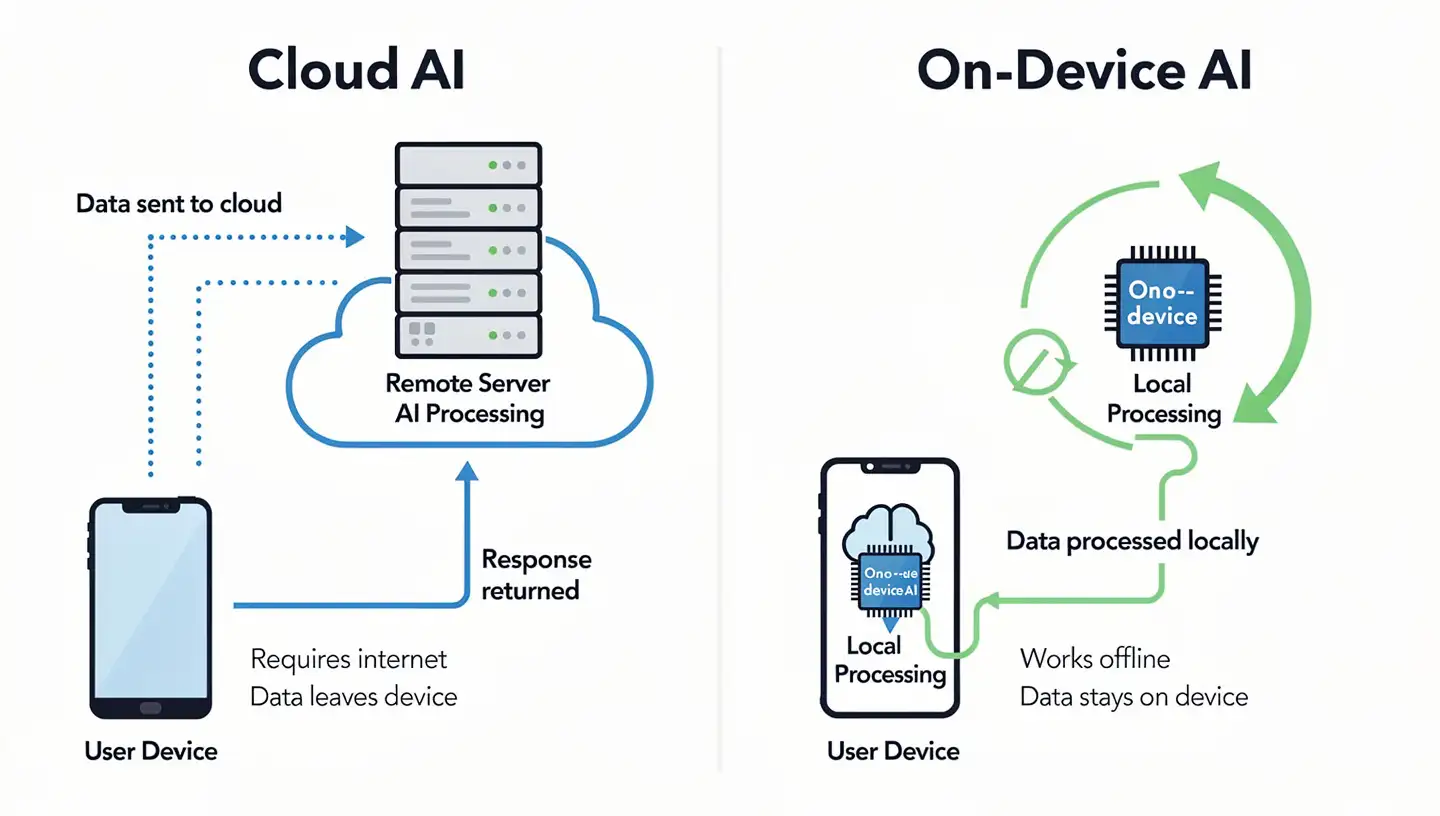
On-device AI deploys machine learning models directly on the endpoint device, enabling inference — and sometimes training — without a network call. When a user interacts with an on-device application, raw personal data never leaves the device in identifiable form.
Modern smartphones use built-in sensors to feed local models that generate personalized responses without routing data to external servers. Advanced techniques like on-device learning go further: devices train local model updates and share only aggregated, anonymized summaries — improving AI performance over time while keeping individual records local. Existing device security features, such as biometric access and hardware encryption, layer on top to protect the model and its outputs.
This architecture directly satisfies data minimization. Personal data processed by the AI never becomes a GDPR-regulated data transfer because it never leaves the device boundary.
On-Device AI vs. Cloud AI: Compliance Trade-offs
The architecture decision between on-device and cloud-based AI carries direct compliance consequences.
Factor | On-Device AI | Cloud AI |
|---|---|---|
Data transmission | None — stays on device | Personal data sent to servers |
GDPR transfer risk | Minimal | Requires Article 44–50 safeguards for non-EU cloud |
Breach surface | Device only | Network, server, storage, backups |
Data retention control | Inherent — no external copy created | Requires explicit deletion policies |
Processing power | Limited by device hardware | Near-unlimited scalability |
Latency | Real-time, offline-capable | Dependent on network conditions |
Cost model | Higher upfront (model on device) | Variable per query |
Cloud AI requires transmitting data across multiple platforms, increasing the risk of tracking, manipulation, and unauthorized access. Self-hosted AI within EU jurisdiction can simplify compliance by avoiding cross-border transfer obligations under Articles 44–50, and provides precise control over data retention and automated purging. On-device processing goes further still: it dismantles the single points of failure that make centralized architectures a compliance liability.
Real-World Applications
Healthcare
Edge AI in healthcare processes patient data near the source — wearable sensors, bedside monitors, imaging devices — rather than routing it to distant cloud infrastructure. High-resolution medical images can be analyzed on local hardware, eliminating the large-file transfers that create both latency and privacy exposure. The edge healthcare computing market is projected to reach USD 47.23 billion, with privacy compliance serving as a key growth driver.
Consumer Technology
Apple has built its ecosystem around data minimization and on-device processing, restricting data collection to essential device functions and processing user data locally rather than in cloud servers. This approach treats GDPR compliance not as a legal obligation to be managed but as an architectural principle.
Financial Services
Tide, a UK digital bank serving nearly 500,000 businesses, transformed GDPR compliance from a manual burden to an automated process by using metadata platforms to automatically identify, tag, and secure personally identifiable information across its systems — limiting human exposure to sensitive data.
Enterprise Software
On-device generative AI coding assistants allow developers to use AI for sensitive codebases without exposing proprietary source code to external servers. An enterprise developer using an on-device coding assistant retains full GDPR accountability: the data never moves outside the organization's control. Testing platforms like Perfecto demonstrate a complementary approach, offering public cloud, private cloud, or on-premise deployment options so organizations can align infrastructure with their specific GDPR data minimization requirements.

Data Protection by Design and by Default Explained

Private AI vs Cloud AI: Cost, Security, Hybrid Path
Should your enterprise run AI on-premise or in the cloud? Compare cost, security, performance, and the hybrid path 90% of companies will pick by 2026.
What Is On-Device AI? Privacy, Speed, and Real Examples
On-device AI runs models locally on your phone, laptop, or wearable — delivering privacy, low latency, and offline access. Learn how it works in 2026.
Advantages and Known Limitations
On-device AI offers clear compliance advantages. Personal data stays off the network, breach exposure shrinks to the physical device, and organizations can demonstrate inherent data minimization to regulators without complex additional safeguards. Lightweight, open-source models now make local processing viable on consumer hardware, further accelerating adoption.
Limitations are real but manageable. On-device models are constrained by device hardware and cannot match cloud-scale systems for workloads like large-scale model training or complex cross-dataset analytics. Privacy experts also caution that on-device learning should be communicated to users in terms of concrete privacy benefits — not technical implementation detail — to satisfy GDPR's transparency obligation. On-device architecture simplifies compliance, but organizations must still document processing activities, honor data subject rights, and maintain appropriate transparency.
Frequently Asked Questions
What is data minimization under GDPR?
Data minimization is a binding GDPR principle under Article 5(1)(c). It requires personal data to be adequate, relevant, and limited to what is strictly necessary for the stated processing purpose. Organizations may not collect or retain more data than the purpose demands.
How does on-device AI help with GDPR compliance?
On-device AI processes data locally on the user's device without transmitting it to cloud servers. This inherently restricts the volume, exposure, and retention of personal data — satisfying data minimization requirements through architecture rather than policy.
What is the difference between on-device AI and edge AI?
On-device AI runs directly on end-user devices, keeping data within the physical device boundary. Edge AI is broader and includes nearby servers and gateways. Both avoid centralized cloud transmission, but on-device AI offers the strongest GDPR privacy guarantees.
Can on-device AI fully replace cloud AI for GDPR-regulated workloads?
Not always. On-device models trade computational scale for privacy. Complex analytics and large-model training may still require server infrastructure. A hybrid approach — on-device inference combined with self-hosted, EU-based infrastructure for aggregation — often best balances compliance and capability.
Which industries benefit most from on-device AI for privacy compliance?
Healthcare, financial services, and enterprise software gain the most. These sectors process sensitive personal data under GDPR and face high breach-risk penalties, making the inherent data minimization of on-device processing especially valuable.
Conclusion
On-device AI reframes GDPR compliance: instead of building technical safeguards around data that shouldn't have left the device, organizations can prevent the exposure from the start. Data that never travels to a cloud server cannot be intercepted, leaked, or transferred without authorization.
For legal, compliance, and IT teams evaluating AI adoption under GDPR, the architecture decision is a compliance decision. If inference can happen on-device, the compliance case is clear: data minimization becomes structural, not cosmetic. Start there — then build outward only where on-device processing genuinely cannot meet the workload.