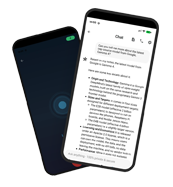
Your Private, Offline AI Assistant.
Take notes and chat with a smart AI agent directly on your Android device. No cloud, completely private, and 100% free.
download
What Is On-Device AI? Privacy, Speed, and Real Examples
By 2025, Gartner projects roughly 75% of all enterprise data will be generated outside traditional data centers. That single statistic explains why the AI industry's center of gravity is shifting from cloud servers to the chip in your pocket. On-device AI — once a research curiosity — is now standard in flagship phones, wearables, and AI PCs.
TL;DR: On-device AI runs artificial intelligence models locally on your smartphone, laptop, or wearable instead of sending data to the cloud. The benefits are faster response times, stronger privacy, and offline functionality — but smaller models and hardware limits create real trade-offs.
AI-generated image
What Is On-Device AI?
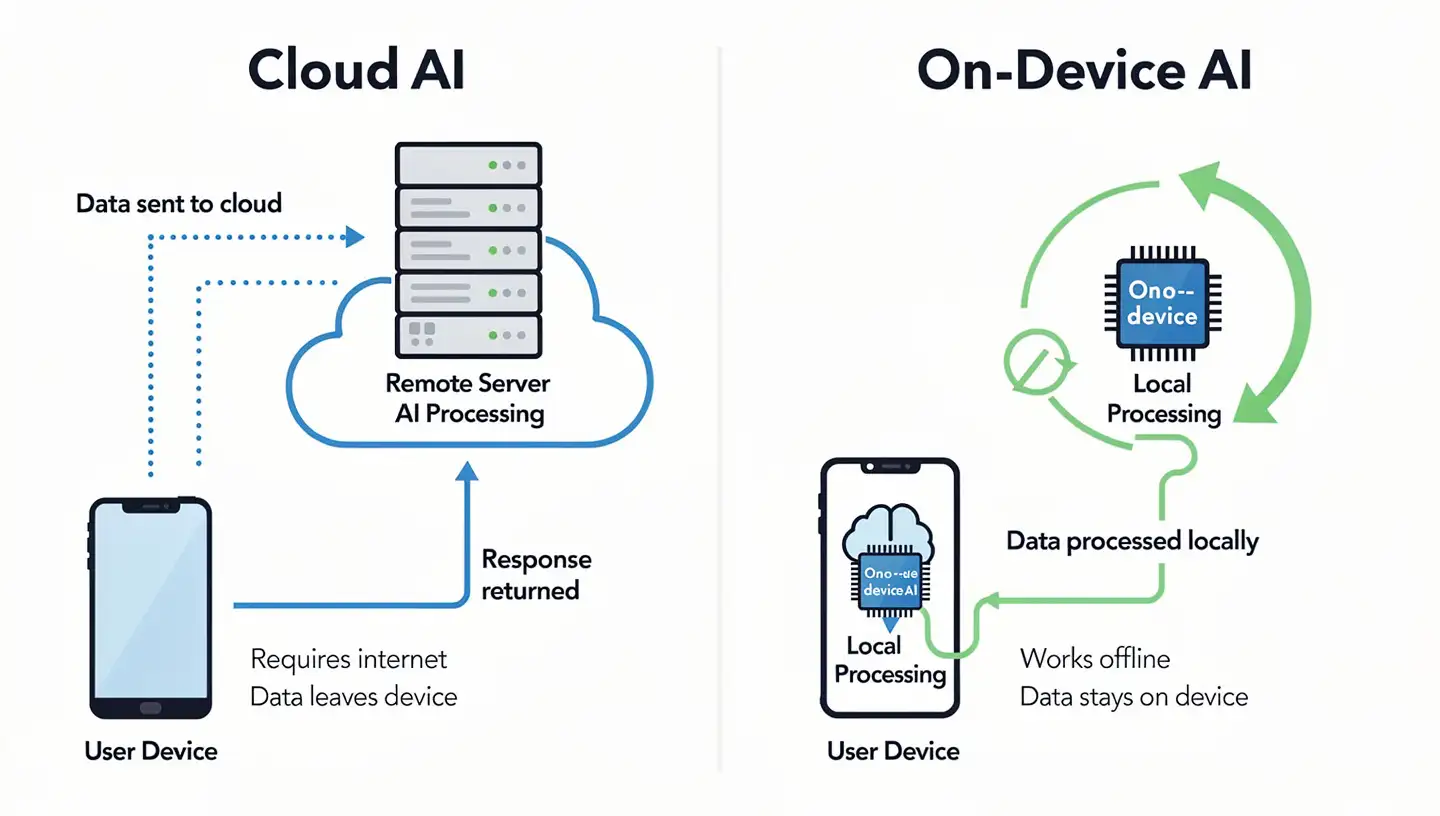
On-device AI is the execution of AI models directly on local devices — smartphones, laptops, wearables, and Internet of Things (IoT) devices — rather than sending data to cloud servers for processing. It enables real-time inference and decision-making at the point of interaction, without constant reliance on cloud infrastructure.
These models are purpose-built for local deployment, optimized for three traits the cloud takes for granted: real-time responsiveness, tight resource budgets, and data-stays-here privacy. The shift is driven by the explosion of IoT and the growing demand for processing data where it is generated, rather than shuttling it back to a data center.
You may also see on-device AI called edge AI or AI on the edge — the terms are largely interchangeable.
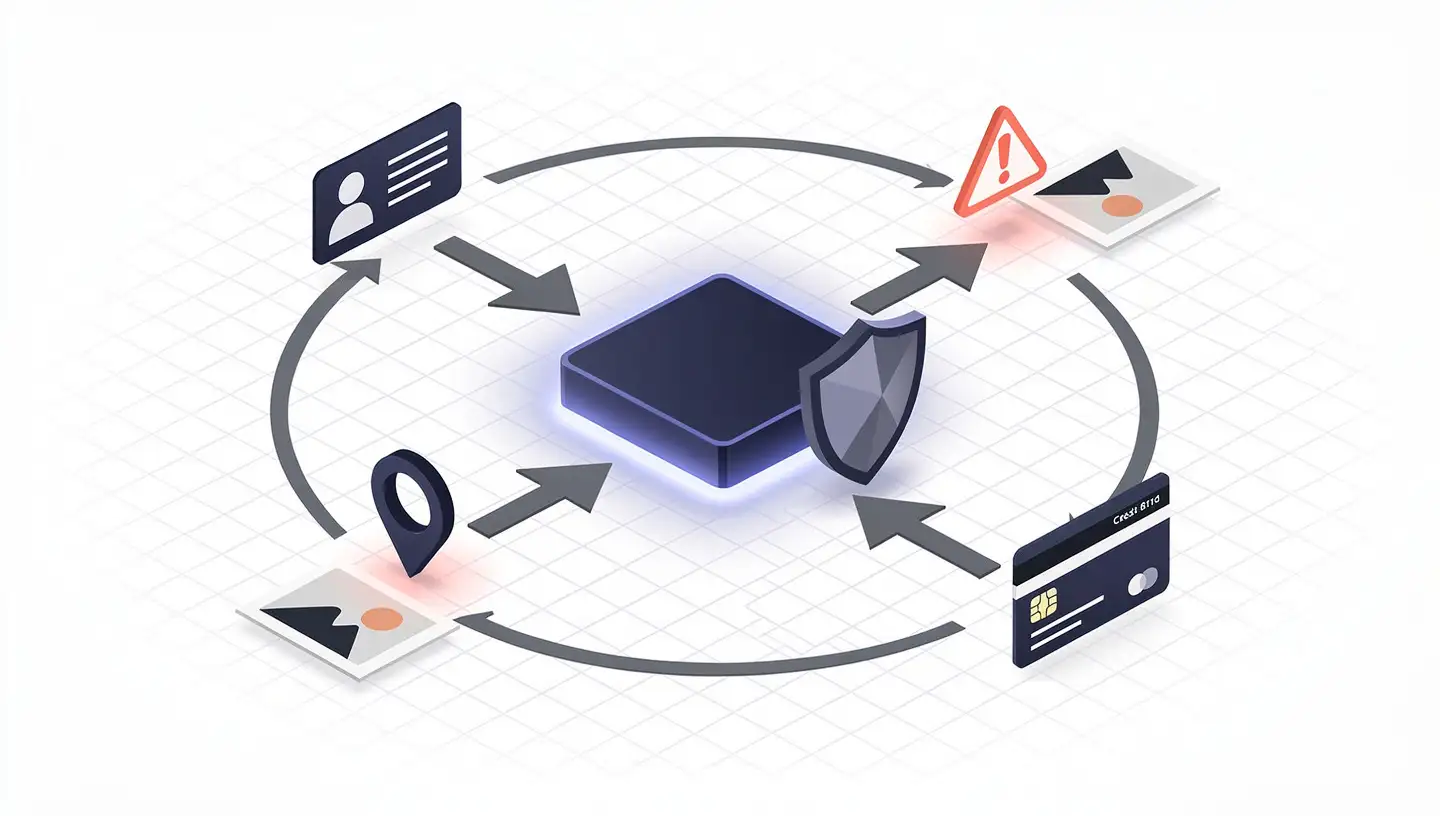
AI Privacy Explained: How AI Uses Your Personal Data
Learn how AI systems collect, process, and use your personal data — the privacy risks, real-world examples, GDPR protections, and how to protect yourself.
Key Benefits of On-Device AI
Privacy and data sovereignty
Because the model runs locally, sensitive data never leaves the device. That reduces exposure to data breaches and hacking — a particularly important consideration in healthcare and finance, where personal data is highly regulated. With local AI, your data is not sent to a vendor's servers and not used for training or advertising. For enterprises, this architecture maintains full control over sensitive data and supports compliance with GDPR, HIPAA, and the EU AI Act.
Ultra-low latency
Local processing eliminates the cloud round-trip entirely. For applications that demand instant reactions — voice assistants, augmented reality, autonomous driving — even a few hundred milliseconds of network latency is unacceptable. On-device inference removes that bottleneck.
Offline capability
On-device AI keeps working when the network doesn't. That matters during flights, in rural areas, in hospitals with strict network policies, and in any scenario where connectivity is unreliable. Unlike cloud AI, edge AI devices can function offline, which is what makes them suitable for safety-critical applications.
On-Device AI vs. Cloud AI
The two approaches solve different problems. The right choice depends on the workload.
Dimension | On-Device AI | Cloud AI |
|---|---|---|
Where it runs | Local hardware (phone, laptop, sensor) | Remote data center |
Latency | Ultra-low — no network round-trip | Higher — bound by network speed |
Privacy | Data stays on the device | Data transmitted to third-party servers |
Offline use | Yes — works without internet | No — requires connectivity |
Compute ceiling | Constrained by device hardware | Effectively unlimited |
Cost model | No per-inference API fee | Usage-based pricing |
Best for | Real-time, private, always-on tasks | Large-model training, heavy inference |
The benefits of edge AI in summary: reduced latency, lower bandwidth usage, real-time processing, enhanced data privacy, and lower operational costs.
AI-generated image
Real-World Examples of On-Device AI
Smartphones
Smartphones are the most visible deployment. They use on-device AI to optimize RAM, adjust battery profiles, generate contextual replies, and power computational photography. Recent examples include splitting a bill captured in a photo or computing totals from a receipt — entirely on-device.
The hardware story matters here. As of early 2026, dedicated neural engines such as Apple's A18 / A19 Pro and Google's Tensor G4 / G5 are standard in flagship phones, enabling efficient local AI processing. Apple Intelligence — integrated into iOS 18, iPadOS 18, and macOS Sequoia — runs a ~3-billion-parameter on-device language model fine-tuned for writing, image generation, and cross-app interactions.
Healthcare and wearables
Edge AI is reshaping clinical workflows. It reduces diagnosis and treatment times and enables real-time patient monitoring through IoT devices, supporting fast information exchange among clinicians during emergencies. Wearable and medical devices can monitor health metrics and respond autonomously without sending data to the cloud.
Industrial and security
On the factory floor, edge AI detects malfunctions in real time and triggers immediate repairs. Modern security cameras run image recognition locally, keeping sensitive footage off the network and eliminating cloud latency. Organizations adopt edge AI to optimize workflows, automate processes, and lower costs while improving security posture.
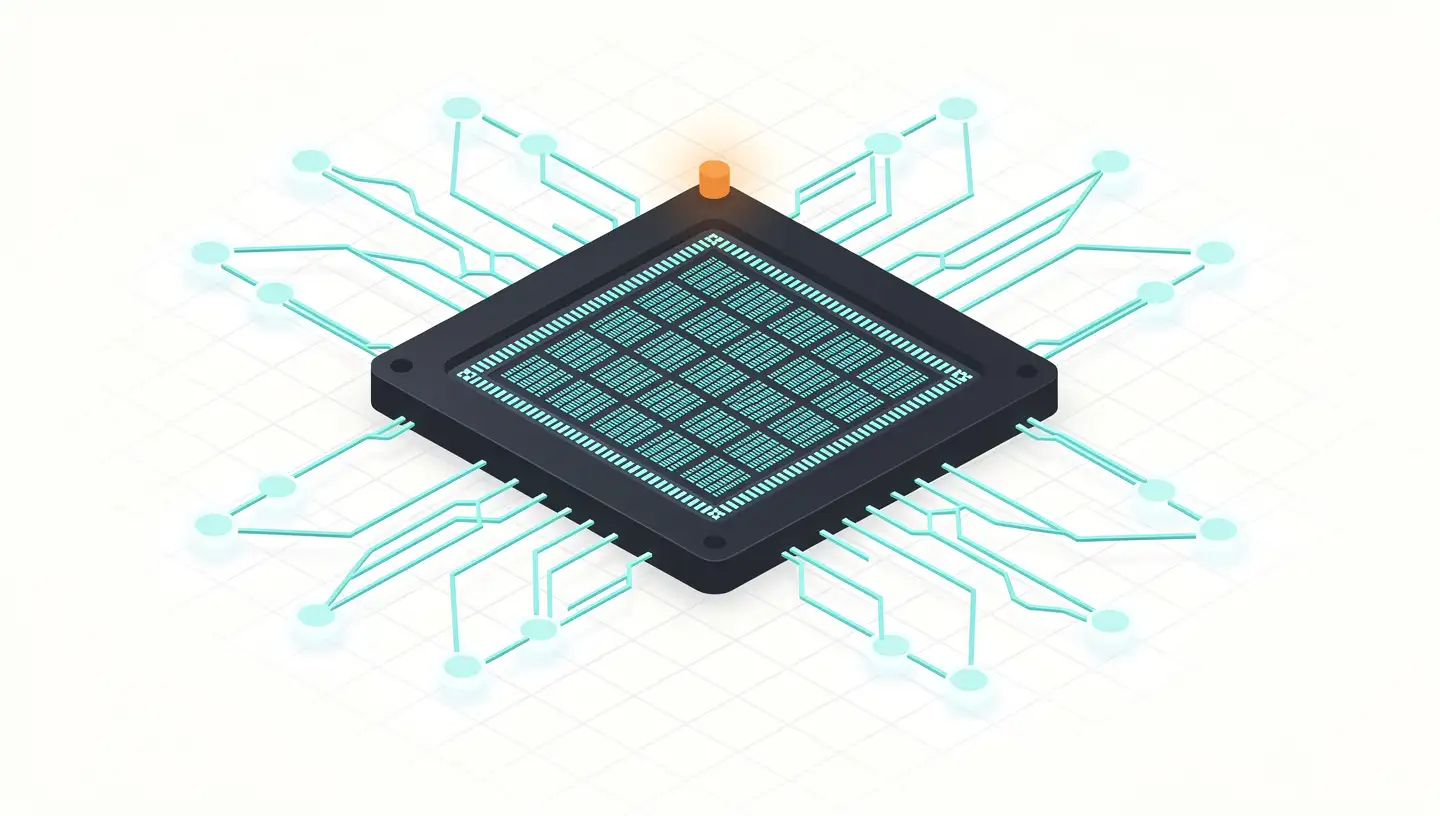
NPU Explained: How Neural Processing Units Power AI
NPUs are specialized chips built for AI workloads. Learn how Neural Processing Units differ from CPUs and GPUs, who makes them, and why they matter in 2026.
Challenges and Limitations of On-Device AI
The trade-offs are real and worth understanding before designing around the technology.
Model size vs. device memory. Effective on-device AI requires aggressive model compression and pruning, because edge devices cannot host the parameter counts cloud models routinely use. Innovative strategies for compression, optimization, and environment-specific adaptation are an active research area.
Accuracy vs. efficiency. Shrinking a model usually costs some accuracy or scalability — the trade-off you accept for local execution.
Older hardware. Devices more than a few generations old often lack the compute needed for complex AI tasks, narrowing the target install base.
Update complexity. Pushing model updates across millions of physical devices is harder than updating a single cloud endpoint.
Regulatory variance. Data protection regulations vary by region, so on-device deployments must support local compliance requirements. The EU AI Act — with full enforcement scheduled for August 2026 — is itself a tailwind for on-device approaches because it tightens limits on cloud-based data processing.
Market Growth and 2026–2033 Outlook
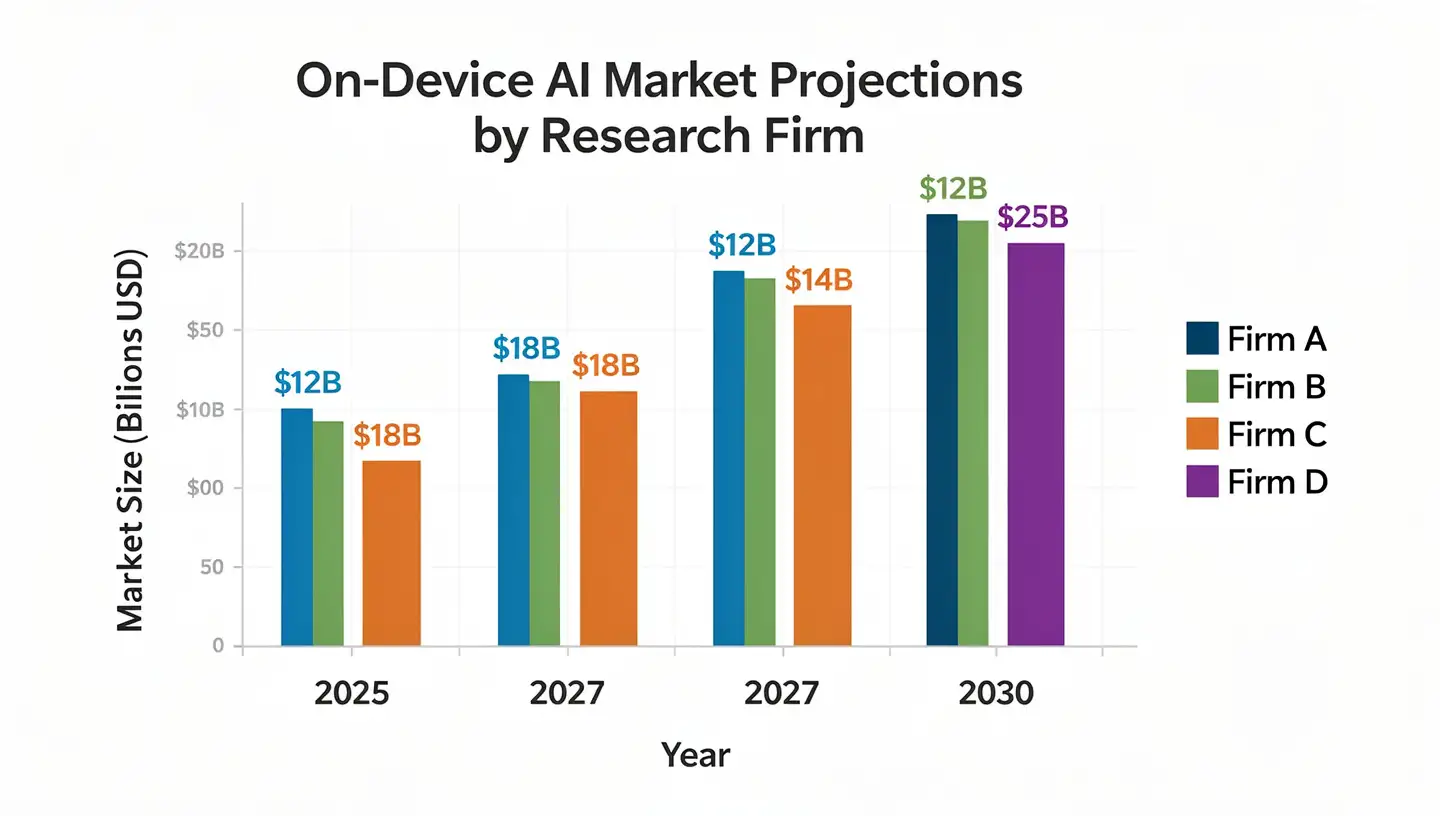
Different analysts measure different segments and time horizons, so figures vary — but the direction is consistent.
Grand View Research valued the global edge AI market at USD 24.91 billion in 2025, projected to reach USD 118.69 billion by 2033 at a 21.7% CAGR.
Grand View Research (on-device AI specifically) estimated the market at USD 10.76 billion in 2025, projected to hit USD 75.51 billion by 2033 at a 27.8% CAGR.
Technavio projects the on-device AI market will grow by USD 150.98 billion at a 28.5% CAGR from 2025 to 2030.
PS Market Research sized the global on-device AI market at USD 17.8 billion in 2025, projected to reach USD 89.4 billion by 2032 at a 26.2% CAGR.
A few signals stand out across these reports. The hardware segment commands the largest revenue share — 56.6% in 2025 by Grand View Research's measure — driven by demand for high-performance silicon capable of running models on-device. Wearables are the fastest-growing category, projected at a 26.8% CAGR through 2032. Asia-Pacific is the fastest-growing region, expected to grow at a 27.0% CAGR from 2026 to 2032. And by 2025, AI PCs are projected to make up 31% of total PC shipments, with roughly 77 million units shipped globally.
The common thread: privacy and security expectations are pushing organizations toward local processing rather than cloud-only architectures.
AI-generated image
Frequently Asked Questions
What is on-device AI?
On-device AI is the execution of AI models directly on a local device — phone, laptop, wearable, or IoT sensor — instead of sending data to cloud servers for processing. It enables real-time inference and decision-making without constant internet access.
How is on-device AI different from cloud AI?
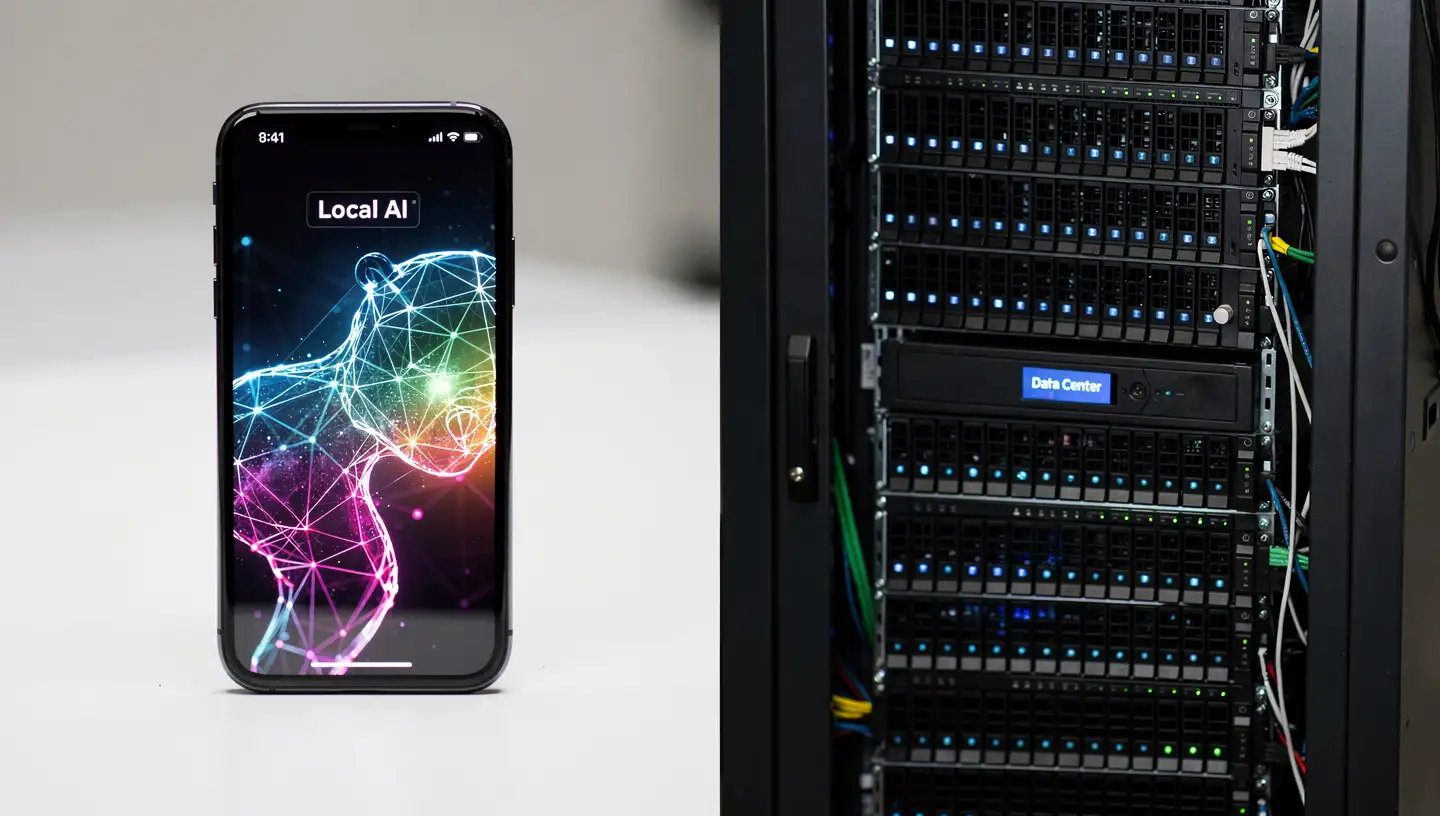
Cloud AI processes data on remote servers; on-device AI processes it locally. Cloud delivers near-unlimited compute but adds network latency and privacy exposure. On-device is faster and private but constrained by device hardware.
What devices use on-device AI?
Smartphones, AI PCs, wearables, smart cameras, AR/VR headsets, and industrial IoT sensors. Flagship phones with dedicated neural engines like Apple's A18 / A19 Pro or Google's Tensor G4 / G5 routinely run sophisticated models on-device.
Is on-device AI more private than cloud AI?
Generally yes. Because data stays on the device, there is no transmission to third-party servers — which reduces breach exposure and supports compliance with GDPR, HIPAA, and the EU AI Act.
What are the main limitations of on-device AI?
Hardware constraints force model compression and pruning, which trade some accuracy for efficiency. Older devices may lack the compute for complex models, and rolling out updates across many devices is logistically harder than updating a single cloud endpoint.
Conclusion
On-device AI is no longer the future — it's the default for any workload that needs to be fast, private, or offline. The privacy story is the strongest immediate driver, the latency story is the most visible to end users, and the hardware story (NPUs in every flagship phone, AI PCs taking 31% of PC shipments) is what makes the rest possible.
The cloud isn't going away — large-model training and heavy inference still belong there. But for the workloads in your pocket and on your wrist, the gravity has shifted, and it isn't shifting back.
Want to keep up? Bookmark this guide, share it with a colleague evaluating on-device vs. cloud architectures, and follow the next post in this series — a deeper look at how NPUs actually deliver these speedups.
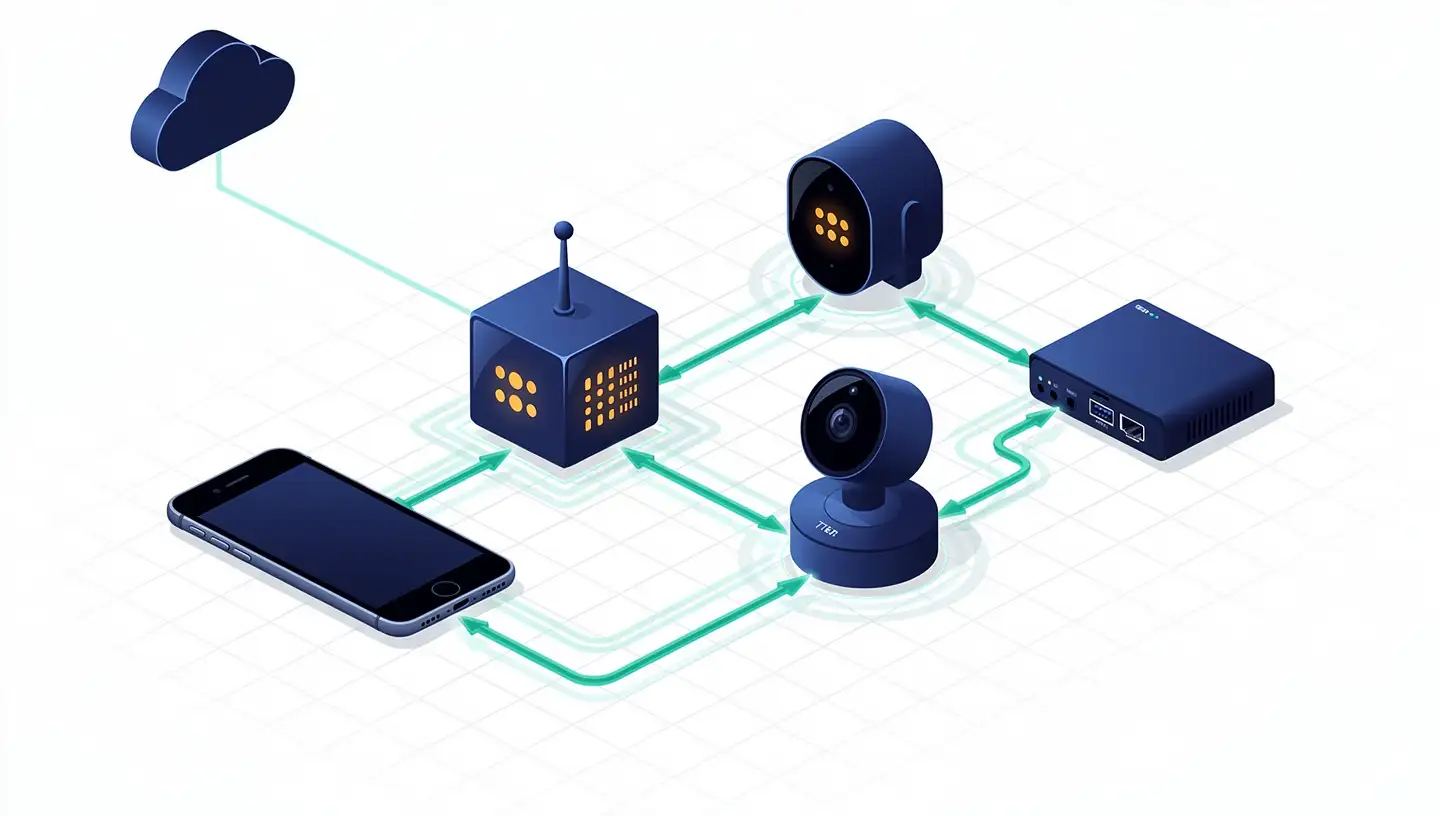
Edge AI Explained: How Edge Computing Powers On-Device AI
Edge AI processes data on or near your device — reducing latency, improving privacy, and saving bandwidth. Here's how edge computing complements on-device AI.