Your Private, Offline AI Assistant.
Take notes and chat with a smart AI agent directly on your Android device. No cloud, completely private, and 100% free.
download
Private AI vs Cloud AI: A 2026 Enterprise Decision Guide
60% of IT leaders surveyed by IDC say on-premise AI is lower in cost or equal in cost to public cloud AI services — directly contradicting the assumption that cloud is always the cheapest path. Add the EU AI Act, which proposes fines of up to €35 million or 7% of global turnover for non-compliance, and the deployment decision becomes more than an IT choice. It's a board-level one.
TL;DR: Private AI runs on your own infrastructure (on-premise or private cloud); cloud AI runs on third-party services. Private AI wins on data sovereignty, compliance, and often cost-for-sustained-workloads. Cloud AI wins on operational flexibility, time-to-deploy, and access to the latest models. Most enterprises end up on a hybrid path that combines both — sensitive workloads stay private, variable workloads use the cloud.
Private AI is artificial intelligence developed, deployed, and managed within an organization's own infrastructure or a dedicated secure environment — keeping sensitive data private and giving full control over its processing and storage.
AI-generated image
The Two Models: What Private AI and Cloud AI Actually Mean
Private AI
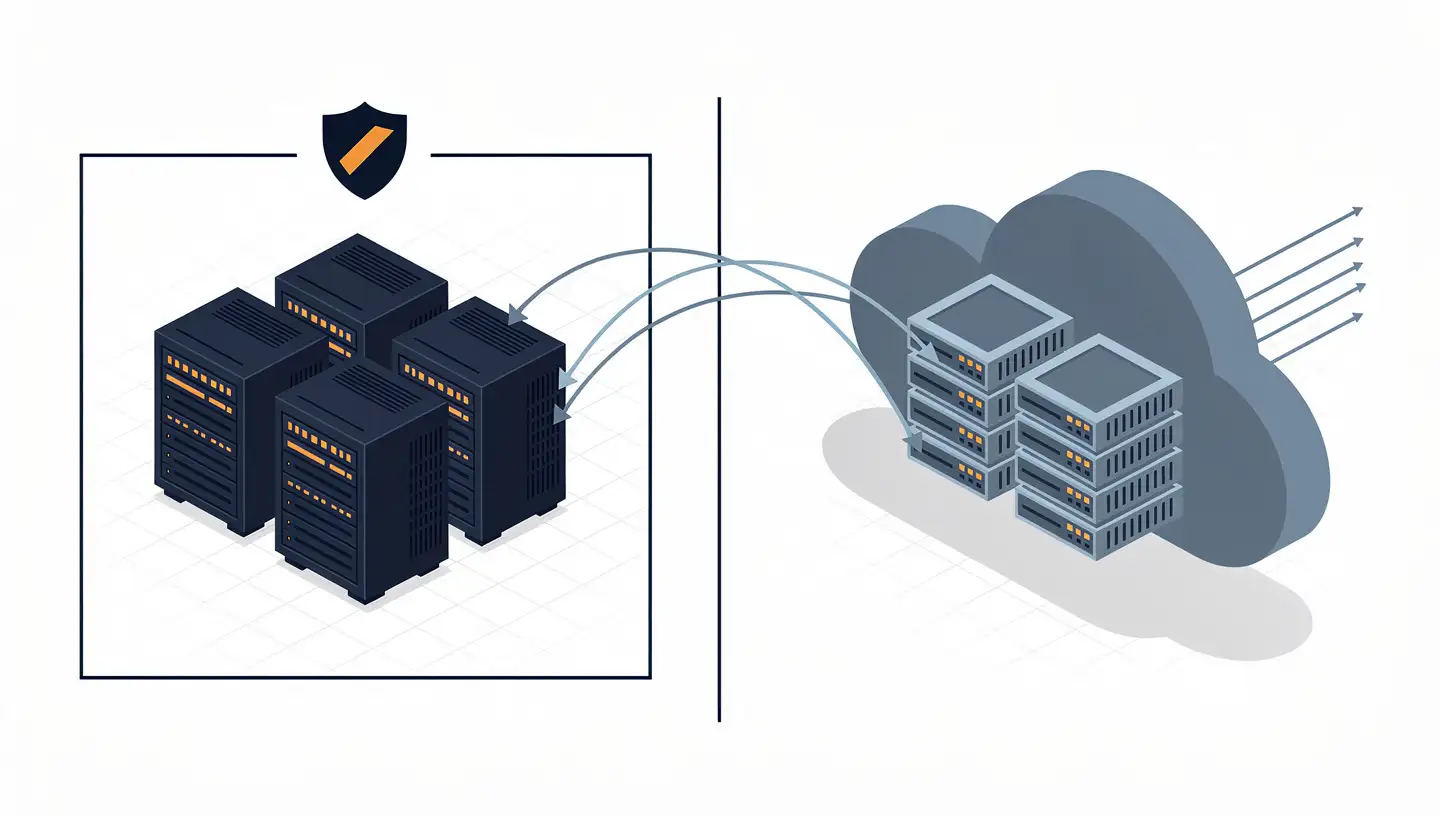
Private AI operates on-premises or in a private cloud, giving the organization full control over data and compliance and supporting customization that public AI services typically don't allow. At the strictest end, "air-gapped" deployments keep AI systems entirely disconnected from the public internet, so sensitive data remains inside the governance boundary during both training and inference.
This model appeals most strongly to organizations in regulated industries — financial services, healthcare, government, and defense — where data sovereignty isn't preferred, it's required.
Cloud AI
Cloud AI delivers AI-as-a-Service (AIaaS): organizations send data payloads to third-party vendors via an API and receive responses. Cloud AI platforms integrate AI algorithms with the scalability of cloud computing, letting organizations deploy advanced capabilities without significant capital investment.
The market is concentrated. As of Q1 2026, AWS holds 28% of the worldwide cloud infrastructure market, Microsoft Azure 21%, and Google Cloud 14%. This concentration drives continuous innovation in service offerings — but it also concentrates the data of nearly every enterprise on AI inside three providers.
The fundamental distinction
Where each model places the data is where each model places the control. Private AI keeps processing inside the organization's boundary, giving IT and compliance teams complete visibility into data flows, model behavior, and access patterns. Cloud AI offloads infrastructure to a provider, trading direct control for operational simplicity and elastic scale.
Factor | Private AI | Cloud AI |
|---|---|---|
Where it runs | On-premise / private cloud | Third-party provider |
Data sovereignty | Stays in your boundary | Sent to vendor via API |
Cost model | High CapEx, lower OpEx | Pay-as-you-go OpEx |
Operational flexibility | Fixed capacity, custom hardware | Elastic scaling |
Compliance posture | Direct control, easier audits | Requires vendor assurances |
Time to first deployment | Weeks to months | Minutes |
Best for | Sustained workloads, regulated data | Variable workloads, experimentation |
Cost Reality: It's Not What You'd Assume
The conventional wisdom — "cloud is always cheaper" — turns out to be wrong for a substantial portion of workloads. 60% of respondents in an IDC survey reported that on-premises AI is lower in cost or equal in cost to public cloud AI services.
The intuition behind this finding: cloud AI's pay-as-you-go pricing is excellent for variable workloads but expensive for sustained, high-volume inference. Once your usage stabilizes, the cumulative OpEx of cloud often exceeds the amortized cost of private infrastructure.
Two structural factors strengthen the private-AI cost case:
Small language models (SLMs) — designed for specific, task-focused domains — offer similar capabilities to large language models at reduced computational requirements, making them appealing for cost-effective private deployments.
Lower total cost of ownership claims from private AI vendors. VMware's Private AI Foundation with NVIDIA explicitly targets unlocking AI productivity while providing lower TCO than equivalent cloud services.
That said, self-hosting AI involves real trade-offs. Self-hosted models give you privacy, security, and control, but cloud-based tools often offer better short and mid-term price-to-performance ratios and dramatically easier daily usage.
The cost decision ultimately comes down to workload predictability: sustained, high-volume workloads favor private; variable or experimental workloads favor cloud.
Security and Compliance: The Strongest Case for Private AI
Security is the most-cited reason enterprises choose private AI. 55% of organizations avoid certain AI use cases entirely due to data-related concerns, and that number is itself a measure of unmet demand — workloads that would happen if a trusted deployment model existed.
Private AI addresses this directly. By operating within the organization's infrastructure or a private cloud, it ensures full control over data and supports compliance with regulations like GDPR, HIPAA, and the EU AI Act. The EU AI Act in particular proposes fines of up to €35 million or 7% of global turnover for non-compliance — a number that changes how boards think about deployment risk.
Two practical examples from enterprise AI tooling:
Augment Code became the first AI coding assistant to achieve ISO/IEC 42001 certification, using a non-extractable API architecture so that even its own administrators cannot access customer code.
Tabnine offers both cloud and on-premises deployment options, letting enterprise users run models fully air-gapped when sensitive code is involved.
Government agencies and law enforcement are also turning to private AI for the same reason: maintaining control over highly sensitive information while complying with regulations on AI.
The fundamental security trade-off is one of trust. Private AI requires organizations to build and operate their own controls. Cloud AI requires trusting a third party to operate them. Neither is inherently safer — the difference is in who is accountable, who is liable, and where the data physically resides at the moment of breach.
Data Governance: Who Owns and Sees What
Data governance encompasses ownership, processing protocols, storage locations, and access controls. The deployment model materially changes how each works.
Private AI gives the organization complete data governance authority. Data used to train and operate models never leaves the organization's infrastructure, audit trails are end-to-end, and compliance demonstrations don't require contractual assurances from third parties. Vendors like Model Mind AI provide platforms that let organizations securely upload, engage with, and interact with their own private data using AI.
Cloud AI requires careful contract review. Data residency options, processing agreements, retention policies, and cross-border transfer commitments all become part of the procurement process — and the right answers depend on the regulatory environment of every jurisdiction the organization operates in.
A general principle emerges: when data is regulated, sensitive, or competitively valuable, governance is easier when the data doesn't leave.
Operational Flexibility: Where Cloud AI Wins
Cloud AI provides inherent operational flexibility through elastic scaling. Organizations can provision additional compute during peak demand and scale back during quiet periods, paying only for what they use. This elasticity is particularly valuable for organizations with variable workloads or those experimenting with AI capabilities before committing to permanent infrastructure investment.
Private AI requires upfront capacity planning — anticipating peak workloads and provisioning accordingly. This can result in underutilized resources during off-peak periods, but it also allows hardware tuning, deep integration, and operational latency that cloud services can't always match.
A useful frame: cloud AI is operationally flexible at the cost of strategic flexibility. Private AI inverts that — strategically flexible (you can do anything you want with the model and the data), at the cost of operational rigidity.
The Hybrid Path: Why Most Enterprises End Up Here
The hybrid model has become the de facto enterprise pattern — not because it's a compromise, but because it matches the real distribution of enterprise workloads.
A hybrid cloud combines public and private environments, allowing organizations to optimize workload placement, balance cost and performance, and meet compliance needs. Organizations prefer hybrid for several converging reasons: data residency rules, phased cloud migration, low-latency requirements, and compliance with specific regulations.
The architectural fit for AI workloads is natural. Sensitive workloads requiring strict data control run on private infrastructure. Less sensitive, variable-demand workloads tap cloud resources. Model training (data-heavy, expensive) can happen on-premise; experimentation and prototyping happen in the cloud. The hybrid model lets enterprises combine public-cloud features like up-to-date technology and quick response to business demands with the control and security of on-premise data centers.
Federated learning is one technology pushing the hybrid frontier further: it enables privacy-preserving computation across distributed datasets, so models can train across multiple private datasets without centralizing sensitive information. It's a glimpse of what comes after "cloud vs on-premise" stops being the right framing.
Who's Adopting Private AI Today
Private AI adoption is concentrated in sectors where data sensitivity is highest.
Financial services organizations are at the forefront of adoption, using private AI to securely process sensitive data and ensure compliance with stringent regulations while improving operational efficiency.
Public sector and law enforcement agencies use private AI to manage and analyze large volumes of case data — maintaining control over highly sensitive information while accelerating case resolution.
Customer service teams are deploying private AI in back-end operations (rather than in customer-facing chat), boosting ticket resolution rates and productivity while ensuring data privacy.
Government agencies worldwide are turning to private AI specifically to comply with various global regulations on AI.
The common thread: AI value is unblocked by the architecture, not the algorithm. 67% of organizations report getting significant or very significant value from AI today. The deployment model determines whether the other 33% can join them.
The Cloud AI Market: Still Growing Fast
For context on what private AI is competing against:
Global cloud AI market: 121.74Bin2025,projected121.74Bin2025,projected1,728.40B by 2033 — a 39.3% CAGR.
A second forecast (Fortune Business Insights) values the cloud AI market at 102.09Bin2025,growingto102.09Bin2025,growingto780.64B by 2034 at a 23.8% CAGR — different methodology, same direction.
Q1 2026 cloud infrastructure spending: $129B, up 35% year-over-year.
Cloud infrastructure revenues projected to exceed $500 billion for the first time in 2026.
The cloud market growth rate has now increased for ten consecutive quarters, driven primarily by AI.
These are not numbers that suggest cloud AI is going away. They're numbers that suggest the cloud AI market is large enough that even small percentage shifts toward private deployment translate to billion-dollar markets of their own.
Challenges of Private AI
Private AI is not free of trade-offs.
Capital costs. Private AI requires substantial upfront investment in GPUs, accelerators, and supporting infrastructure. Compared to the OpEx model of cloud services, the CapEx burden is significant — particularly for organizations without strong existing data center operations.
Specialized talent. Building and maintaining private AI systems requires AI/ML engineers, data scientists, and infrastructure specialists. The talent market for these roles is tight, and small-team organizations may find the staffing burden harder than the hardware burden.
Maintenance. Cloud providers handle model updates, security patches, hardware refreshes, and performance optimization automatically. Private deployments do all of this themselves.
Slower access to new capabilities. Cloud AI providers ship the latest models and architectures continuously. Private deployments require testing and integration cycles before adopting them.
The rise of small language models offers a partial answer: these specialized models often run on less expensive infrastructure while delivering competitive performance for specific business functions.
Decision Framework: Which Model Fits Your Workload
A practical checklist, working from the strongest signals first.
Choose Private AI when:
Data is regulated (financial services, healthcare, government, defense)
Workloads are sustained and predictable
Complete data sovereignty is required
Competitive advantage depends on training on proprietary data
The organization has the infrastructure operations capacity to support it
Choose Cloud AI when:
Speed of deployment is the priority
Workloads are variable or experimental
Internal AI expertise is limited
Access to the latest models is critical
Capital is constrained relative to expected usage
Choose Hybrid when:
Different workloads have different sensitivities — most enterprises
Migration is phased
Some workloads are cost-optimized on-premise while others benefit from cloud elasticity
Compliance varies by data type or jurisdiction
According to the AI deployment perspective from Mirantis, 70% of organizations expecting to increase their AI budgets indicate a need to change or modernize IT infrastructure to support generative AI deployments — meaning the deployment model decision is on the table whether you wanted it there or not.
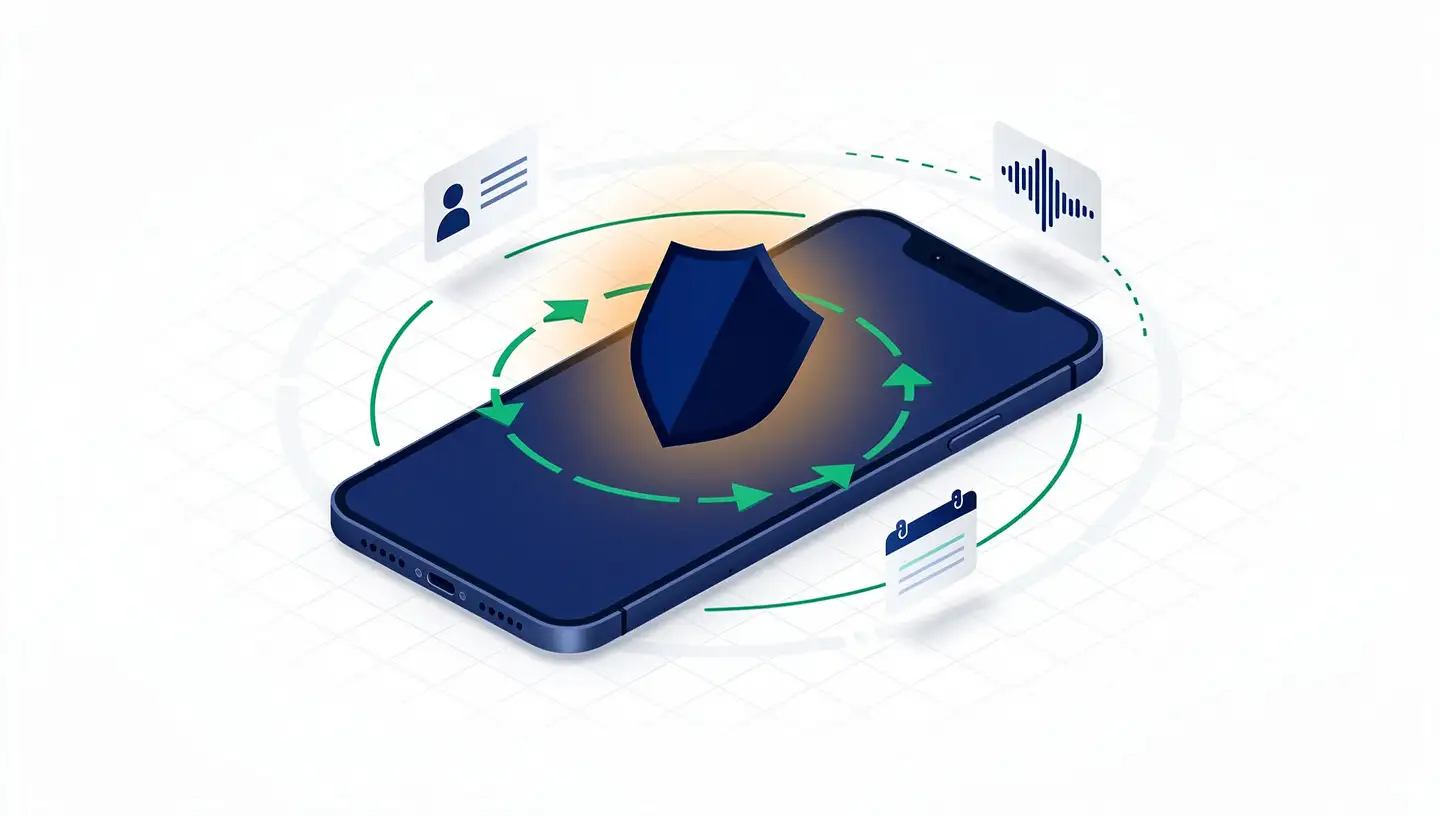
On-Device AI and GDPR: Achieving Data Minimization
On-device AI satisfies GDPR data minimization by keeping personal data on the device. Real examples from healthcare, financial services, and enterprise software.
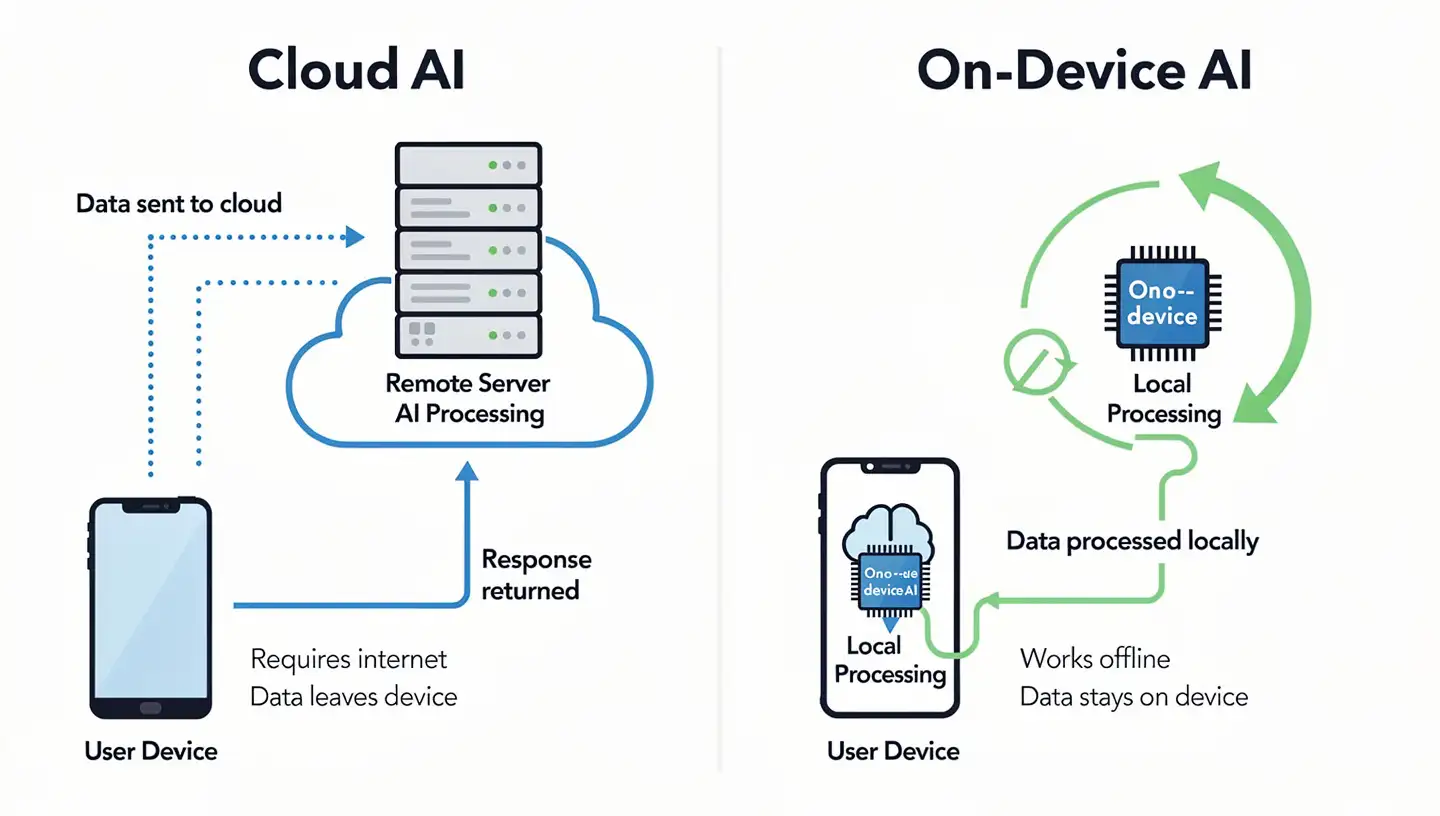
What Is On-Device AI? Privacy, Speed, and Real Examples
On-device AI runs models locally on your phone, laptop, or wearable — delivering privacy, low latency, and offline access. Learn how it works in 2026.
Frequently Asked Questions
What is private AI?
Private AI is artificial intelligence that's developed, deployed, and managed within an organization's own infrastructure — on-premises or in a private cloud — so that sensitive data never leaves the organization's control. It contrasts with cloud AI services, where data is sent to third-party providers for processing.
Is private AI cheaper than cloud AI?
Often, yes — for sustained, predictable workloads. An IDC survey found that 60% of respondents reported on-premises AI was lower in cost or equal in cost to public cloud AI services. The trade-off is upfront capital expenditure: private AI requires hardware investment, while cloud AI uses pay-as-you-go pricing that's cheaper for variable or experimental workloads.
Is private AI more secure than cloud AI?
Private AI offers stronger data sovereignty by keeping sensitive data within the organization's governance boundary, including the option to fully air-gap from the public internet. Cloud AI providers invest heavily in security infrastructure as well; the right choice depends on the organization's data sensitivity, regulatory environment, and ability to maintain robust security controls in either model.
What is a hybrid AI deployment?
A hybrid AI deployment combines private infrastructure for sensitive workloads with cloud resources for scale and experimentation. It lets enterprises run sensitive data on-premises while using cloud AI services for variable workloads, accessing the latest models, and avoiding the full capital cost of private infrastructure for everything.
When should an enterprise choose private AI?
When data is highly sensitive or subject to strict regulations (financial services, healthcare, government), when workloads are sustained and predictable enough to justify infrastructure investment, when complete data sovereignty is required, or when competitive advantage depends on training models on proprietary data without exposing it to third parties.
Conclusion
The choice between private AI and cloud AI is not a single technology decision — it's a structural commitment that touches cost, security, governance, and how quickly the organization can move on AI initiatives. Cloud AI is growing explosively, on track to exceed $500 billion in cloud infrastructure revenues in 2026. Private AI is becoming the preferred choice in regulated industries where data sovereignty is non-negotiable.
The binary framing is the trap. Most enterprises end up on a hybrid path — sensitive and sustained workloads on private infrastructure, variable and experimental workloads on cloud, with a clear policy for what lives where.
If you're making this decision now, start with the workloads, not the platforms. Map each AI workload by data sensitivity, volume predictability, and regulatory exposure. Then route each one to the model that matches. The organizations leading on enterprise AI are not the ones that picked cloud or picked private — they're the ones that learned to match every workload to its right deployment environment.